The media wall is where flexible stone meets the hardest combination of services in any residential project: a TV that needs structure, a soundbar that needs mass, consoles and boxes that need ventilation, cables that need invisible routes, and a stone face that needs none of the above to touch it. Get the integration right and the wall reads as a designed stone feature with electronics that happen to live in it; get it wrong and every service announces itself — a bracket shadow through the stone, a cable hatch off-centre, a soundbar bolted visibly to the finish. This guide covers the media wall as a system: structure behind the stone, the layering order, cable routes and ventilation, and the details that keep the face intact for the life of the equipment.
What carries the TV — and what the stone must never carry
The rule that governs everything else: the television mounts to structure, and the stone is the skin that closes over it. A wall-mounted TV of any meaningful size loads its fixing points with tens of kilograms plus lever forces, and no bonded 2–8 mm sheet is part of that structure. The mount lands on blocking or a frame behind the substrate, positioned from the TV’s VESA pattern before the wall is clad, and its stand-off is set so the finished stone face clears the mount’s arm through its full motion — the depth arithmetic that our backing board guide starts and the finished-face dimension completes.
What the stone can carry is modest by design: light accessories on plates that spread load, cable hatches, the soundbar if its weight and fixings say so — and even then through to structure, never bonded to the sheet. The test for any proposed wall accessory is the same one our glass junction guide applies to storefront fittings: does it reach structure? If yes, detail the penetration. If no, it does not belong on the stone.
What is the layering order on a media wall?
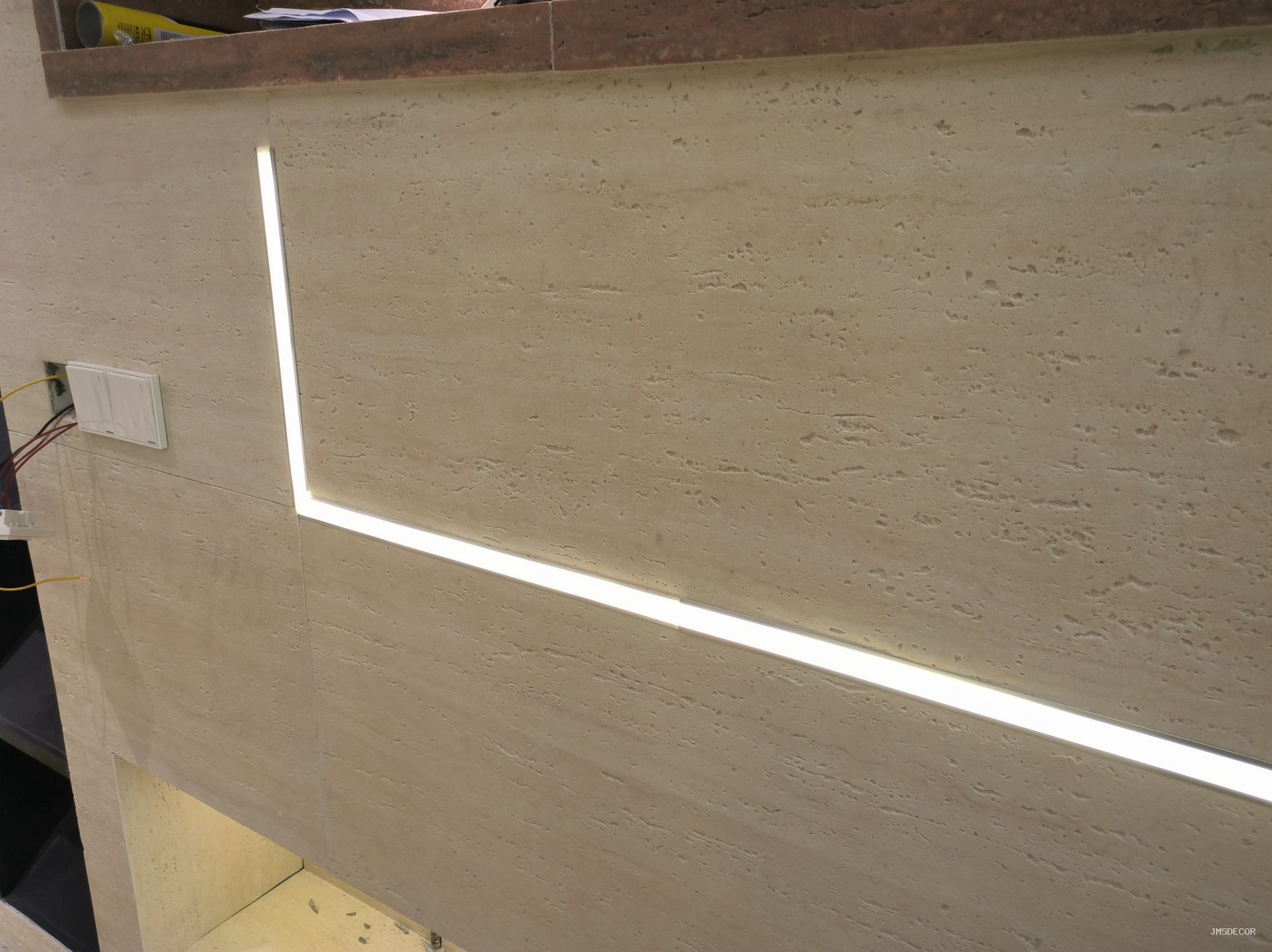
The build reads back to front. Structure first: blocking at the TV position, at the soundbar line, at any shelf or console fixing — every future load mapped on the framing drawing before boards close the wall. Substrate second: the flat, jointed board our backing guide specifies, with its surface at the depth the finished face calculation requires. Services third: cables in conduit or trunking where they run, boxes set to finished depth per our socket finishing guide, ventilation paths for any enclosed cavity left open. Stone last: templated openings, full-coverage bonding, and the cover-plate logic that hides every cut.
Two layers deserve special attention because media walls get them wrong most often. The cable route must be serviceable — a conduit with a draw line, not cables pinched behind stone that cannot be opened without a re-clad. And the cavity behind the TV, where boxes and drivers live, needs both access and airflow: a vented hatch detailed like the removable panels in our access panel guide, porque el equipamiento del interior se mantendrá mucho antes de que lo sea la pared.
¿Cómo cruzan los cables la cara de piedra sin visibilidad?
Los cables atraviesan la piedra acabada de tres formas honestas, y el diseño debe decidir cuál antes de cortar las placas. La ruta de placa: cada cable llega a una caja detrás del televisor o consola, y el único corte visible es el que oculta su placa de cubierta; el resultado más limpio, y el que requiere que la ruta se trace antes del revestimiento. La ruta de canal: un perfil de canalización o línea ligera lleva la bajada desde la pantalla hasta la consola, elegido como elemento vertical diseñado que se lee como parte de la composición, no como un parche. La ruta de cavidad: cuando la piedra está sobre un tabique, los cables discurren por la cavidad detrás de él y solo emergen en las cajas de registro; invisibles en todo el recorrido excepto en los dos extremos.
Lo que ninguna de estas opciones tolera es el pensamiento posterior: rajado sobre la cara de piedra ya acabada, adhesión de canalización con cola sobre la placa, o perforación in situ durante el montaje final porque nadie trazó la ruta. Cada una de esas soluciones es un parche visible sobre una cara que no permite arreglos invisibles — el defecto exacto que nuestro repair guide describe como evitable pero permanente.
¿Qué necesita la capa de barra de sonido y altavoces?
Las barras de sonido y los altavoces empotrados plantean dos exigencias que la piedra debe respetar: anclaje estructural y comportamiento acústico. La barra de sonido se fija a la estructura atravesando la pared terminada con un separador que deja libre la cara de piedra; su peso y cualquier resonancia aconsejan trazar la línea de refuerzo en su posición exacta, no de forma aproximada. Los altavoces empotrados se montan en sus propias cajas traseras, recortadas en el sustrato antes del revestimiento y acabados con rejillas que descansan sobre la cara de piedra; el emplazamiento se acotiza y corta según la disciplina de los enchufes, porque una rejilla de altavoz cubre un círculo, no un marcaje irregular.
Acústicamente, la piedra es una superficie rígida y reflectante, exactamente lo que busca una pared multimedia detrás de la pantalla, pero justo lo que no se desea en el resto de la estancia. La respuesta de diseño es la zonificación: piedra en la pared multimedia donde predomina la imagen, y acabados absorbentes en los paramentos laterales y techo donde predomina el sonido. Una pared de cine recubierta totalmente de piedra combate su propia acústica; una pared multimedia de piedra en una sala con tratamiento acústico en el resto favorece tanto la imagen como el sonido.
¿Cómo se replantea la pared para que la tecnología parezca parte del dibujo?
Las paredes multimedia se juzgan por su alineación, y la alineación es un ejercicio de replanteo. El centro del televisor, la línea de la barra de sonido, la parte superior de la consola, las posiciones de los enchufes y cualquier estante derivan de una misma referencia, normalmente la línea de ojos sentado, y la cuadrícula de paneles los acomoda sin cruzarlos: sin junta en la apertura del televisor, sin costura detrás de la barra de sonido, ni tira estrecha junto a una placa de cubierta. Las reglas de replanteo de juntas de nuestro guía de juntas apply, with the media wall’s extra rule added: every service position is on the drawing before the grid is fixed, because the grid that ignores the services will be re-cut on site.
The finished-face dimension ties it together. Boxes set to finished depth, the mount’s stand-off calculated against the stone’s thickness band, the reveal of any niche sized for the equipment it shelters — one dimension chain, drawn once, checked before the first sheet is bonded. Media walls that look effortless are the ones where that chain was never broken.
What does the media wall look like when the design wants more than a flat screen?
The flat TV wall is the base case; the specification range goes further, and the same system carries it. A recessed TV niche turns the screen into a framed element — the recess built and clad per our niche guide, with the screen set back and the returns detailed so soundbars, cameras and cables live inside the reveal instead of on the wall. A full-height stone field with the screen as one panel among others suits the rooms where the wall is the architecture and the TV is a guest — the screen’s aperture templated like any opening, its bezel line landing on the panel grid. And the motorised or art-mode screen adds one requirement: clearance for movement and heat at the aperture edge, so the stone’s stop line respects the screen’s worst-case geometry, not its hung position.
Each variant changes the depth chain, not the method. The finished-face calculation absorbs the mount, the niche and the stand-off; the blocking drawing absorbs the loads; the panel grid absorbs the geometry. A media wall is therefore never “more complicated” than its flat cousin — only drawn with one more pass of the same discipline.
How does the stone behave around the TV’s heat and electronics?
Screens, consoles and amplifiers shed heat, and the stone wall is the surface that closes the room around them. The material itself is comfortable with the temperatures consumer electronics produce — a mineral face over mesh sees far harsher cycles on a sunlit facade — but the cavity behind the screen is the detail that matters: sealed hot air degrades equipment and softens nothing in the stone, while a vented cavity keeps both healthy. The ventilation path belongs in the same drawing as the cables: low inlet, high outlet, through grilles that read as design elements rather than holes, per the serviceable-hatch logic from our access panel guide.
The second electronics factor is electromagnetic and practical rather than thermal: serviceability. Amplifiers, network gear and console storage all need hands-on access, and the media wall that buries them behind bonded stone has converted its electronics into demolition jobs. The cavities that hold equipment get the removable-panel treatment — the carrier logic from our reversible installation guide, applied at hatch scale — and the wall keeps its stone face for decades while its electronics are swapped as often as the client likes.
PREGUNTAS FRECUENTES
Can I mount a TV directly onto the flexible stone?
No. The mount fixes to structure behind the wall — blocking or frame — with the stone face closing neatly around it. The sheet carries display loads neither by design nor by warranty.
Do I need to leave ventilation behind the TV?
If equipment lives in the cavity, yes: a vented, serviceable hatch with airflow per the equipment’s documentation. Sealed cavities cook electronics, and opening a sealed stone wall to reach them is a re-clad, not a service call.
What if the client changes TV size after the wall is built?
The mount’s VESA position and the blocking are set for the specified size; a larger TV may land outside them. Design the blocking generously at drawing stage and the smaller change costs a mount, not a wall.
Can the stone go behind an recessed TV niche?
Yes — the niche is built and clad like any recessed detail, per our niche guide, with the TV mounted inside it to structure and the returns detailed so the screen’s edges clear the stone through any tilt.
Structure behind, services planned, stone last — the media wall is a coordination project that happens to look like a feature wall. Formats and thickness data for the face are on the revestimiento de piedra flexible page, and wall-mounting structural practice is documented by standards bodies such as ASTM International.