A European project specifies a fire class before it ever specifies a finish. For wall cladding sold into the European Union and the wider region, that class is read from EN 13501-1. EN 13501-1 Class A2 is the band most commercial projects ask a stone panel to reach, and it decides whether a specification approves the sheet or returns it.
Class A2 sits at the top of the Euroclass scale, one step below A1. It is not a marketing label. It is a measured result from a set of European fire tests, and it decides the paperwork a project has to hold.
EN 13501-1 Class A2 is a measured reaction-to-fire class, not a claim. It says a panel will add almost nothing to a fire once the wall is up.
What EN 13501-1 Class A2 Means
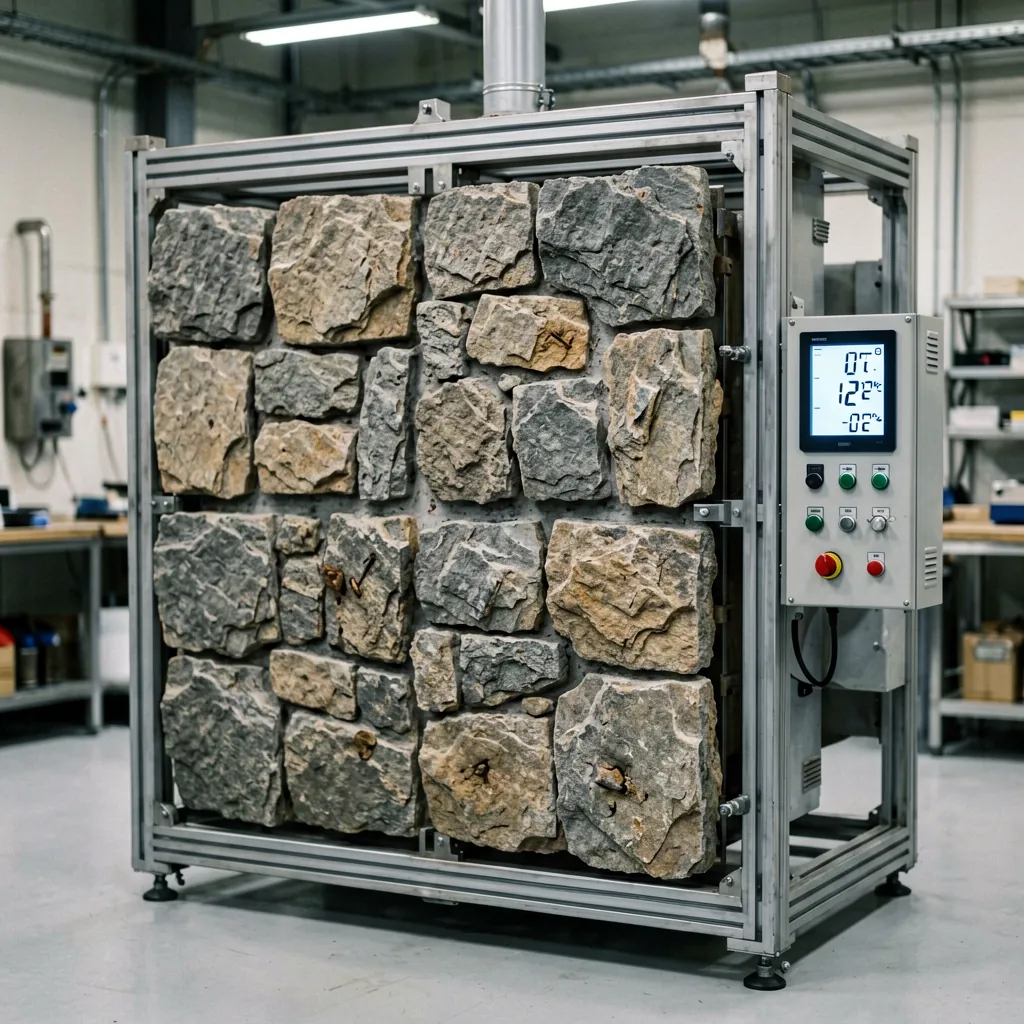
EN 13501-1 is the European standard that classifies how a construction product reacts to fire. It sorts products onto a Euroclass scale that runs from A1 at the top down to F at the bottom. The class travels with the product from the laboratory to the specification sheet.
Class A2 is the highest class below A1. An A1 product is treated as fully non-combustible and adds nothing to a fire. An A2 product is allowed a small, limited contribution, and it is still grouped with A1 at the near non-combustible end of the scale.
The flexible stone panels made by JMS Decor hold EN 13501-1 Class A2, and the class is backed by a certificate and a test report rather than a statement. That pairing matters to a specifier. A claim on a website is not the same as a document a building control officer will accept.
The class is a property of the sheet, not of a coating. It comes from a panel built on a mineral base, so the result travels with the product instead of depending on a surface treatment added later.
A buyer reading a datasheet should treat the class as a line that can be checked, not a badge. It has a test report behind it, a date and a product reference. When any of those is missing, the class is harder to defend in a submittal.
One more distinction saves confusion later. EN 13501-1 describes how a product reacts to fire, which is a material and surface property. It does not describe how long a finished wall resists a fire, which is a fire-resistance rating and a different test. A submittal that confuses the two will be returned.
The Tests Behind a Class A2 Result

A Class A2 result is not produced by a single test. It is assembled from two, and a product has to satisfy both before the class is written down. The first checks the material itself. The second checks how a wall built from it behaves in a fire.
The non-combustibility test, EN ISO 1182, places a sample in a furnace and records whether the material sustains combustion on its own. A product that fails this route cannot reach A2, whatever its surface does.
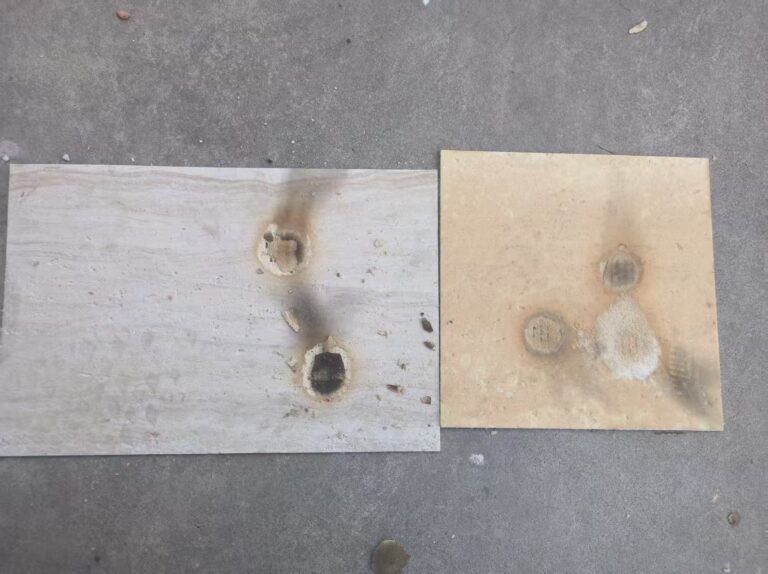
The single burning item test, EN 13823, builds a corner from the panels and burns a propane flame against it. Instruments record heat release, smoke growth and any burning droplets that fall away during the run.
| Test | What it measures |
|---|---|
| EN ISO 1182 non-combustibility | Whether the material itself sustains combustion |
| EN 13823 single burning item | Heat release, smoke growth and falling droplets |
For a panel made from natural stone powder, an inorganic gel and a fibreglass mesh, the mineral base carries the result. There is very little organic material in the build to feed a flame, and that is why the class holds across the range.
The two tests cover different risks on purpose. One asks whether the material can burn by itself. The other asks what happens when a wall of it meets a flame in a corner. A panel has to pass both, which is why a Class A2 sheet is a mineral product rather than a treated surface.
Reading the Euroclass Letters and Numbers
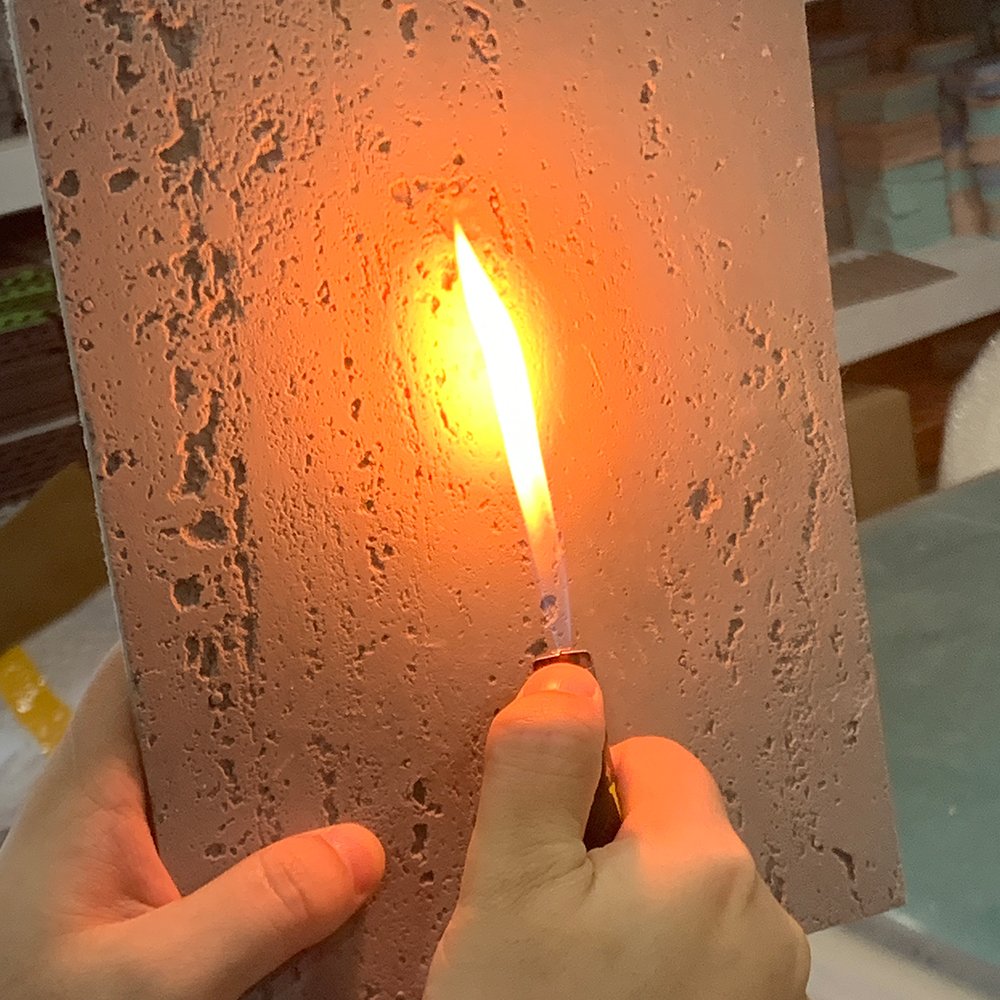
The letter and number are only part of the label. A full EN 13501-1 classification can carry two extra codes, and a specifier who ignores them can approve the wrong sheet for a space.
The first code describes smoke production and runs from s1 for the lowest to s3 for the highest. The second describes flaming droplets and runs from d0 for none to d2 for the worst. A lower number is the better result.
| Klasse | What it means |
|---|---|
| A1 | Fully non-combustible, no contribution to fire |
| A2 | The top class below A1, limited contribution |
| B to E | Progressively more combustible surfaces |
| F | No fire performance declared |
A project can ask for a class and a smoke code together, and the two are read as one string on the drawing. Read the whole label, not the letter alone, before the panel is accepted for a corridor, a lobby or a stair. The wording also feeds the wider file on brandgeschützten Fassadenverkleidungen und Gebäudeversicherungen.
Smoke and droplets matter most in a corridor or a stair, where people leave a building. A panel with a low smoke code keeps the escape route clearer for longer. That is why the code is often quoted beside the class on a specification for these spaces.
For European work the class is quoted in full, with its smoke and droplet codes beside it. The JMS Decor sheet is supplied with its Class A2 certificate, so the declared values can be matched to the schedule line by line.
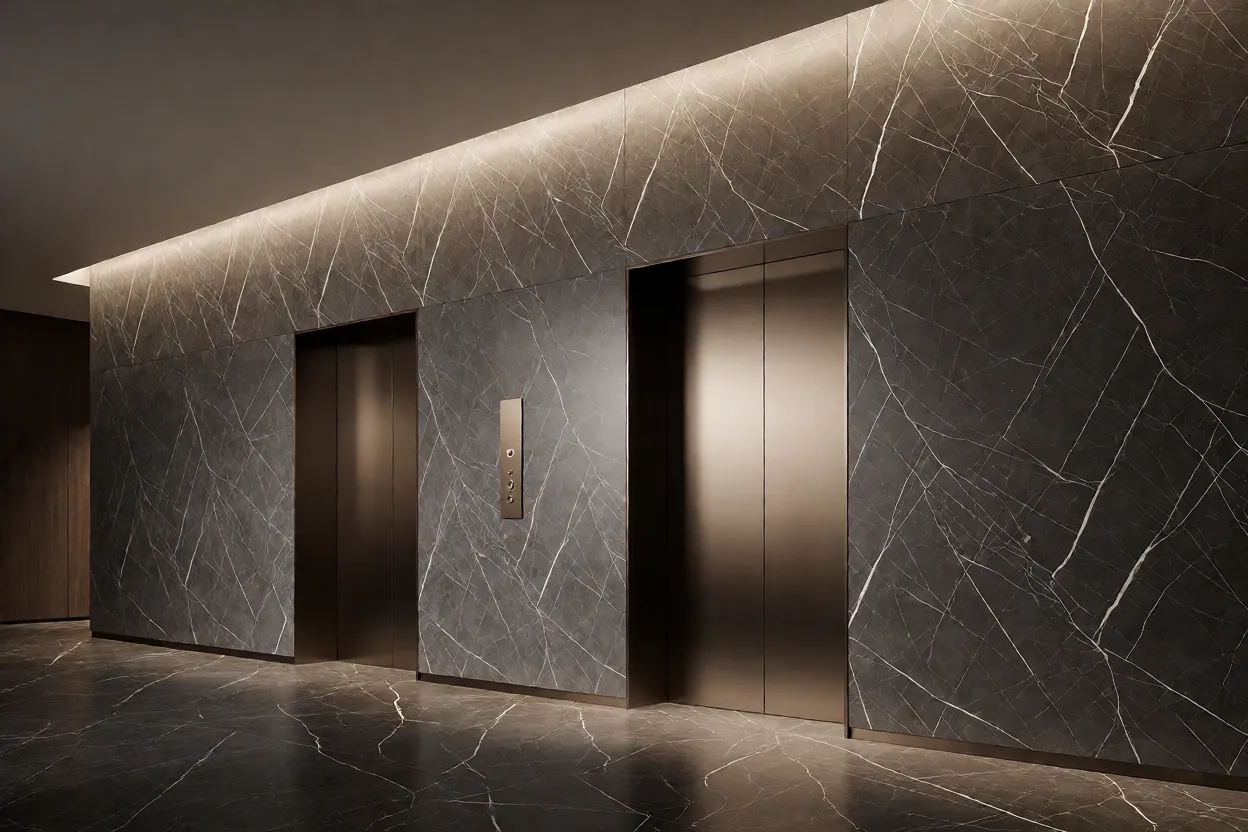
Wo CE-Kennzeichnung auf Brandschutzklasse trifft
In Europa ist die Brandschutzklasse mit der CE-Kennzeichnung verbunden. Die Verordnung über Baumuster verpflichtet den Hersteller zur Veröffentlichung einer Leistungserklärung, wobei die Brandverhaltensklasse einer der deklarierten Werte ist.
Ein CE-kennzeichnertes Paneel ist mehr als ein Paneel mit einem Aufkleber. Das Kennzeichen verweist auf ein Dokument, und in diesem Dokument werden die Klasse sowie der zugrundeliegende Prüfbericht genannt. Der umfassendere Hintergrund findet sich in unserem Leitfaden zu CE-zertifizierten Wandpaneelen für europäische Projekte.
Für einen Importeur ist die Prüfung direkt: Fordern Sie die Leistungserklärung an und vergleichen Sie die deklarierte Brandverhaltensklasse mit der in den Zeichnungen. Wenn beide nicht übereinstimmen, ist das Paneel für den Einsatz ungeeignet.
Die Leistungserklärung wird für jedes Produkt ausgestellt und begleitet es, sodass die Klasse auch noch Jahre nach der Montage nachvollzogen werden kann. Ein Projekt, das das Dokument archiviert, kann eine Anfrage der Bauaufsicht beantworten, ohne für ein neues Zertifikat zum Lieferanten zurückkehren zu müssen.
Unterschiede zwischen Class A2 und ASTM E84
Europäische und nordamerikanische Projekte lesen andere Prüfungen. Europa nutzt EN 13501-1. Die Vereinigten Staaten und Kanada nutzen ASTM E84, wobei Class A die höchste Stufe auf der Skala ist.
ASTM E84 ist ein Oberflächentest. Er verfolgt, wie schnell sich eine Flamme über die Fläche ausbreitet und wie viel Rauch sie freisetzt. Der europäische Test betrachtet das Produkt in einem Raumbrand, einschließlich Wärmefreisetzungsrate und herunterfallenden Tropfen, nicht nur die Oberfläche.
Die Palette umfasst beide Ergebnisse: ASTM E84 Class A bei einer Flammenausbreitungsklasse von 25 oder weniger und EN 13501-1 Class A2 für europäische Projekte. Ein Projekt, das in beide Märkte liefert, kann sich auf ein einziges Dokument von unserem flexible Steinplatten. Der nordamerikanische Teil wird im Leitfaden zu ASTM E84 Class A für Wandpaneelen.
Bei Projekten, die verschiedene Märkte kombinieren, ist der sicherere Ansatz, beide Berichte in einer Datei zu sammeln. Ein Planer kann dann die europäische Klasse gegenüber einer europäischen Behörde und die ASTM-Klasse gegenüber einer nordamerikanischen Behörde für dasselbe Paneel und dieselbe Charge nachweisen.
Sammlung der richtigen Brandschutzunterlagen
1. Eine Brandklasse ist nur so stark wie die Dokumentation dahinter. Bevor eine Paneele-Bestellung erteilt wird, sollten vier Dokumente vorliegen, die jeweils eine andere Frage beantworten.
2. Die Leistungserklärung enthält die deklarierte Klasse. Der Prüfbericht zeigt das zugrundeliegende Rohergebnis. Der ISO 9001 3. Bescheinigung belegt, dass die Fabrik einen gemanagten Prozess führt, und die Chargenbescheinigung verknüpft die gelieferten Platten mit der Produktioncharge, aus der sie stammen.
4. JMS Decor ist neben der CE-Kennzeichnung nach ISO 9001, ISO 14000 und BSCI zertifiziert, und die Produktion weist eine Fehlerrate von unter 1 Prozent auf. Jede Bestellung wird mit der Chargenbescheinigung versandt, erstellt von den Fachleuten hinter diesen Werten. Der vollständige Artikelset liegt unter Hersteller für flexible Stein-Wandpaneele 6. Ein Einreichungsdossier ist stärker, wenn die Dokumente miteinander übereinstimmen. Prüfen Sie, ob die Klasse in der Leistungserklärung mit der im Prüfbericht und im Zeitplan übereinstimmt. Eine Diskrepanz zwischen zweien davon ist der schnellste Weg, ein Paket zur Korrektur zurückzuschicken. Brandschutz- und Klimaschutzkonformität.
7. Häufig gestellte Fragen zu Klasse A2.
8. Die Klasse wird vor einer Bestellung gegen die Spezifikation geprüft.

10. Was ist EN 13501-1 Klasse A2?.
11. Es handelt sich um eine europäische Brandverhaltensklasse für Bauprodukte. A2 liegt direkt unter A1 auf der Euroclass-Skala, sodass ein Paneel einem Brand nur begrenzt Nährboden bietet. Für eine Spezifikation ist dies die Klasse, die ein Verkleidungsprodukt für die oberste Stufe unter vollständig nichtbrennbaren Materialien erreichen muss.
12. Ist Klasse A2 die höchste Brandklasse?.
13. Nein. A1 ist die höchste Klasse und ist Produkten vorbehalten, die als vollständig nichtbrennbar gelten. A2 ist die Klasse direkt darunter. Beide stehen am Ende der Skala nahe der Nichtbrennbarkeit, weit vor den B- bis F-Klassen.
14. Hält flexibles Steinmaterial die EN 13501-1 Klasse A2?.
15. Die JMS Decor Kollektion aus flexiblem Stein verfügt über die Bewertung Klasse A2, die durch ein Zertifikat und einen Prüfbericht untermauert wird. Dasselbe Paneel wird für nordamerikanische Projekte nach ASTM E84 Klasse A getestet, sodass ein Produkt beide Märkte bedient.
The JMS Decor flexible stone range holds the Class A2 rating, and it is supported by a certificate and a test report. The same panel is tested to ASTM E84 Class A for North American projects, so one sheet serves both markets.
Ist EN 13501-1 das gleiche wie ASTM E84?
Nein. Die beiden Tests sind unterschiedlich und gelten für verschiedene Regionen. ASTM E84 ist ein nordamerikanischer Oberflächenbrandtest, bei dem Klasse A die höchste Bewertung ist. EN 13501-1 ist die europäische Norm für das Verhalten von Bauprodukten bei Brandeinwirkung. Die jeweiligen Ergebnisse werden in einer technischen Dokumentation gesondert ausgewiesen.
Welche Dokumente belegen eine Klassifizierung nach A2?
Fordern Sie drei Unterlagen an. Die Leistungserklärung (DoP) gibt die Klasse an, der Prüfbericht belegt das Rohergebnis, und das ISO-9001-Zertifikat bestätigt, dass das Werk nach einem kontrollierten Prozess arbeitet. Ein Chargenzertifikat mit Analysenergebnis verknüpft die gelieferten Platten anschließend mit der jeweiligen Charge.