On a coastal resort, the WPC board usually outlives the metal that holds it. Most specification advice for salt exposure starts with “use 316 stainless,” which is a fastener detail the manufacturer and the engineer own, not a fact every project can copy. The bigger lever is treating the assembly as one corrosion system: board, subframe, clips, screws, and drainage all fail at different rates, and the fixings and the cavity behind the boards fail first. This guide gives the buyer and specifier the questions to ask, the failure sequence to expect, and the detailing decisions that matter more than a single fastener grade. All specific fixings, grades, and cavity dimensions must come from the manufacturer’s installation manual and the project engineer.
Why does a coastal project change the fixing question, not just the board?
Wood-plastic composite is itself tolerant of moisture. It is made from wood flour and thermoplastic, and it does not rot or swell the way solid timber does. That is why WPC is used on terraces, fences, and exterior wall cladding in the first place. The boards can take repeated wet and dry cycles better than the metal connecting them.
Salt spray attacks the weakest link. Screws, clips, rails, and brackets corrode long before the composite board fails. A coastal wall can therefore look fine at the face while the fixing system is quietly losing its grip. When a fixing corrodes through, the board around it moves, the joint opens, water enters behind the panel, and the damage spreads to panels that were never the problem.
This is why the buyer’s question on a coastal project is not “which board” but “is the whole fixing system rated for this exposure.” A WPC panel that is perfect inland can be part of a failing wall on the coast if the hardware behind it is wrong. The material, the hardware, and the detailing have to be specified as one package, and the manufacturer’s guidance governs which combination is approved.
What fails first in a coastal WPC assembly?
Order the components by how quickly they tend to fail in a salt environment, and the specification conversation becomes concrete:
- Fixings and clips. Ordinary plated or carbon-steel fasteners corrode first. They are also the cheapest and most-often-downgraded component, so they are where the specification leaks.
- The subframe and rails. If the battens or rails are a different metal than the fixings, the contact point is where galvanic corrosion starts. Dissimilar metals in a wet salt film behave differently than either metal alone.
- The cavity behind the boards. A drained, ventilated rainscreen cavity that stays clear dries out; a blocked or poorly drained cavity holds salt moisture against the wall for days.
- Joints and edges. Cut collect salt deposits and are the entry points for wind-driven rain.
- The board surface. Usually the last to fail, and the one buyers watch most closely.
The sequence is important because it explains why a “fade-resistant, maintenance-free” board claim does not protect the wall. The marketing point is on the component that fails last. The risk is on the components nobody photographs.
Which questions should I put to the WPC supplier?
Before the order, ask for the manufacturer’s exterior fixing system and treat each answer as an approval document, not a sales reply.
| Question | What a good answer looks like |
|---|---|
| Which fixings does the installation manual specify for a coastal or high-humidity site? | A named fixing system with the corrosion grade, not “any exterior screw” |
| Is the subframe, clips, and screws approved as one compatible system? | A stated system, or explicit isolation details where metals differ |
| What cavity and ventilation does the manual require? | A drained, ventilated detail, with the entry and exit openings defined |
| How does the board move with temperature, and what gap is required? | An expansion allowance and end-joint detail from the manual |
| What is the maintenance and inspection interval? | A schedule to check fixings and drainage, not “maintenance-free forever” |
| Can the system be repaired locally? | A removable-panel or clip detail, so a failed fixing is not a full re-clad |
Confirm the grade the manufacturer requires and whether it matches the site. The specific fastener material for a chloride or sea-spray environment is the manufacturer’s call; the buyer’s job is to make sure that call is written into the purchase order and that the hardware delivered matches it. A substitution to cheaper hardware at the factory is the most common way a coastal wall fails early.
How do dissimilar metals create a coastal problem?
When two different metals touch in the presence of salt moisture, they form a small electrochemical cell, and the less noble metal corrodes faster than it would alone. On a coastal wall, the wet film that makes this possible is in the air constantly. This is why you should not mix a stainless fastener with a plain steel rail without an isolation detail, and why the manufacturer’s approved combination matters.
The practical rule is to treat the metal parts as one system: same family of fixings and subframe, isolated at contact points where the materials genuinely differ, and detailed so the assembly drains. If the project uses an aluminium subframe with steel or stainless fixings, the question is how the manufacturer handles that interface, not whether each metal is individually “corrosion resistant.” The Association for Materials Protection and Performance (AMPP) is the technical body behind corrosion and galvanic-compatibility guidance, and its material is a useful reference when an engineer questions a dissimilar-metal detail.
Why does the drainage cavity matter more than on an inland wall?
Coastal wind-driven rain is different from ordinary rain: it arrives horizontally and carries salt. A drained and ventilated rainscreen cavity lets that water escape and lets the wall dry. The value is in the openings at the top and bottom of the wall and at the penetrations; a cavity that is sealed at the base traps salt water against the substrate.
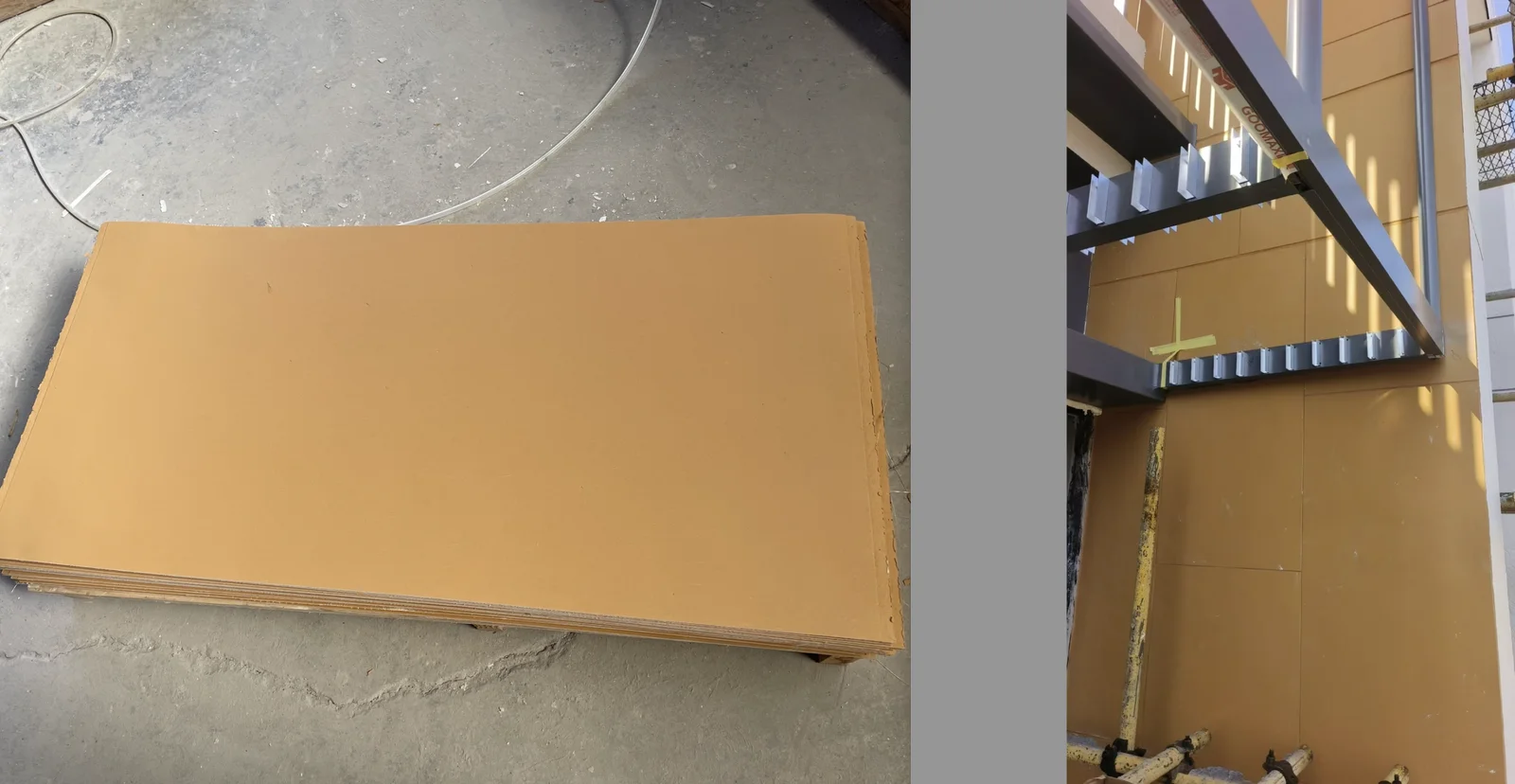
Three detailing points decide whether the cavity works on the coast:
- The bottom of the wall must drain, not pond. Keep the lower edge clear of standing water and do not block the weep path with trim or sealant.
- The cavity must ventilate at both ends so salt moisture can dry, with protection against insects where the project requires it.
- Penetrations and joints must be flashed and sealed so water that gets past the face leaves the way it came or is drained, rather than being held behind the boards.
Sealant is not a substitute for flashing, and a blocked drainage path is a slow failure that shows up as staining and corrosion behind an attractive face. The WPC wall cladding overview covers the cavity and fixing concept for our product range.
How do thermal movement and the coastal sun interact?
WPC expands and contracts with temperature, and a dark board in direct coastal sun runs hotter than the same board in shade. The expansion allowance in the manufacturer’s manual protects the joints; on a sunny facade, the temperature swing that the joint has to absorb is larger. Boards that are trapped at their ends, or fixed too tightly, buckle or open their joints.
The buyer should confirm the required end gaps and the fixing method for the project’s orientation, and should not let an installer run boards tight against a rigid edge “because they look cleaner.” The flexible stone versus WPC comparison is useful here because it contrasts a direct-adhered thin sheet with a mechanically fixed board system: the two move and are fixed in fundamentally different ways, which is exactly why mixed facades need deliberate transition detailing.
What should the purchase order and handover say?
Lock the fixing system, not just the board. The PO line should name the WPC profile, colour, and the required hardware package, with the manufacturer’s coastal guidance referenced. If the project is in a known marine environment, state that the delivered hardware must match the manual’s coastal specification, so a cheaper fastener cannot be substituted at the factory.
At handover, the maintenance file should carry the inspection interval for fixings and drainage, the cleaning method for salt deposits on the face, and the local-repair detail. A coastal wall is a serviceable assembly. The buyer who specifies the board and ignores the hardware and the drainage is buying the component that fails last and skipping the ones that fail first.
For the wider question of which exterior material fits which climate, the facade renovation materials guide und das WPC supplier selection guide cover how to read a supplier’s capability against a real site exposure.
FAQ
Is stainless steel always enough on the coast?
Not by itself. A stainless fixing in contact with a dissimilar metal in a trapped, wet cavity can still corrode, and the grade has to be the one the manufacturer approves for the site. The system, not the single component, is what matters.
Do I need a ventilated cavity on a coastal WPC wall?
Follow the manufacturer’s manual. For a drained rainscreen, the top and bottom openings and the clear drainage path are what let salt moisture dry. A sealed or blocked cavity holds water against the wall.
Can the boards be cleaned of salt?
Use the cleaning method the supplier specifies. Salt deposits on the face are cosmetic if they can be removed; salt moisture trapped behind the boards is a structural and corrosion problem.
What if the site is inland but very sunny?
High solar exposure still drives larger thermal movement, so the expansion allowance and joint detail matter even without salt. The fixings corrode more slowly, but the board movement is still a design point.
Which is more coastal-risk, the board or the hardware?
The hardware and the drainage almost always fail first. A board rated for outdoor use usually outlives the screws and rails that hold it, which is why the fixing system is the specification priority.