The adhesive is not a commodity decision on a flexible stone job, and it is the decision most often made by price. A 2–8 mm mineral-composite sheet behaves differently from tile: it cannot be back-buttered like ceramic without consequence, it follows the substrate instead of bridging it, and in a wet area the bond line sits inside a waterproofed assembly that has to stay flexible. None of that is captured by “grab adhesive” on a shopping list. This guide gives buyers and installers a decision framework: what actually differs between adhesive families, which wall conditions drive the choice, how to read a manufacturer’s approval, and the sequence that proves the bond before a whole wall is committed.
Why the sheet changes the adhesive question
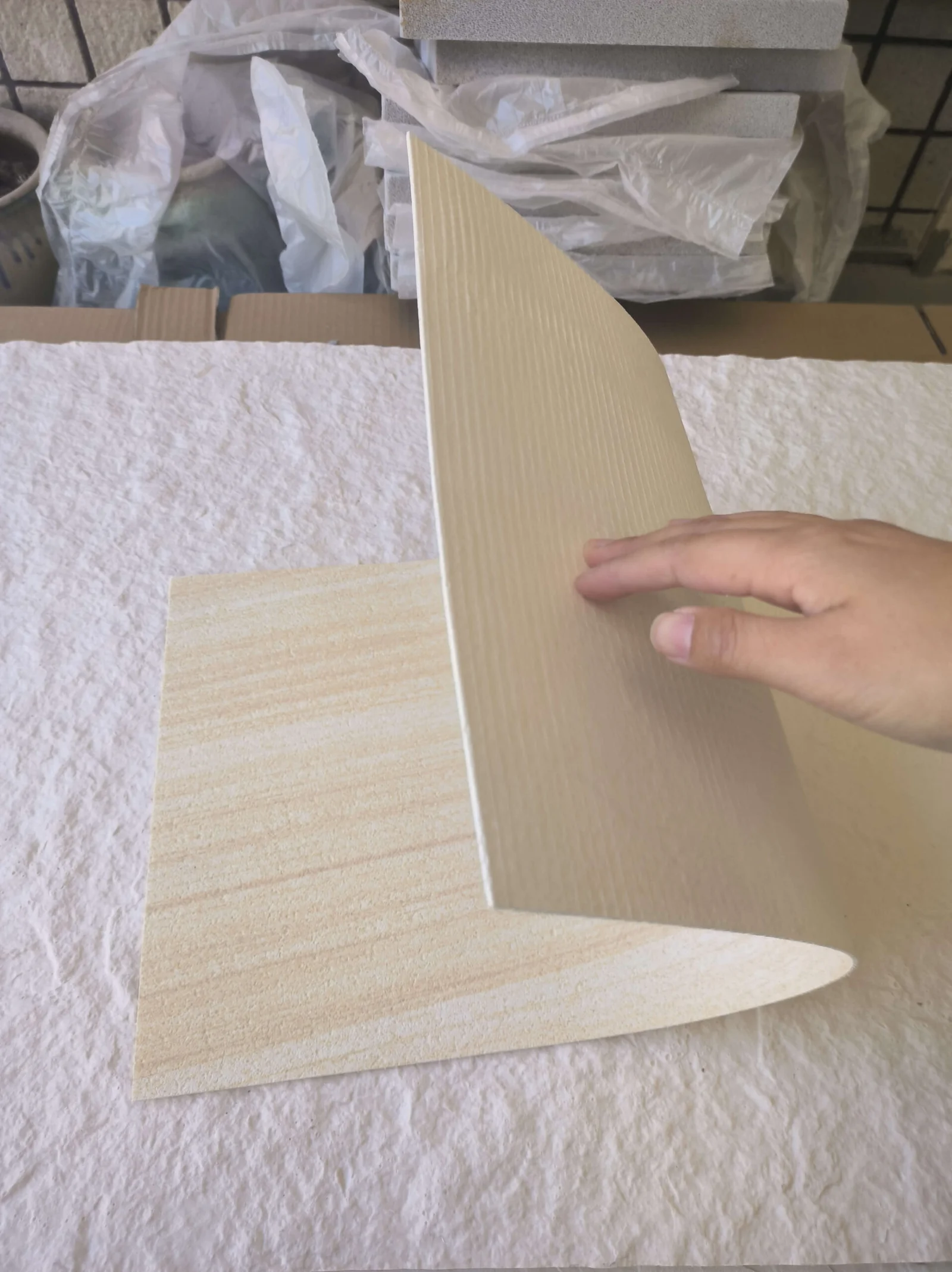
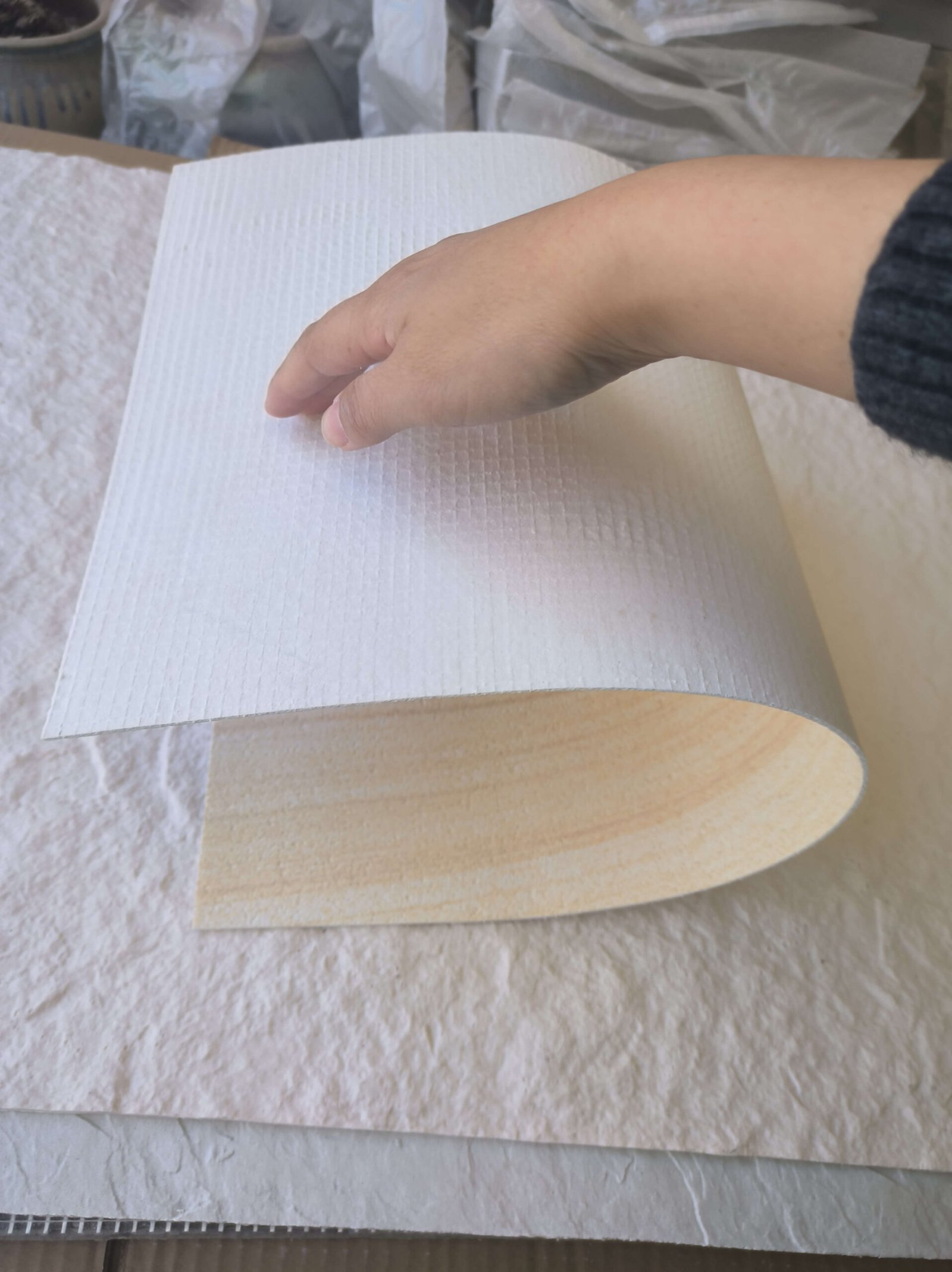
Flexible stone is natural stone powder in an inorganic binder, reinforced with a fiberglass mesh. The mesh gives it strength across the sheet; it does not give it stiffness. Where a rigid tile holds itself flat over a marginal bond, a thin flexible sheet will flex, hollow or telegraph a substrate problem straight through to the visible face. The adhesive bed is therefore doing more work than on tile: it is the only thing keeping the sheet in full contact with the wall.
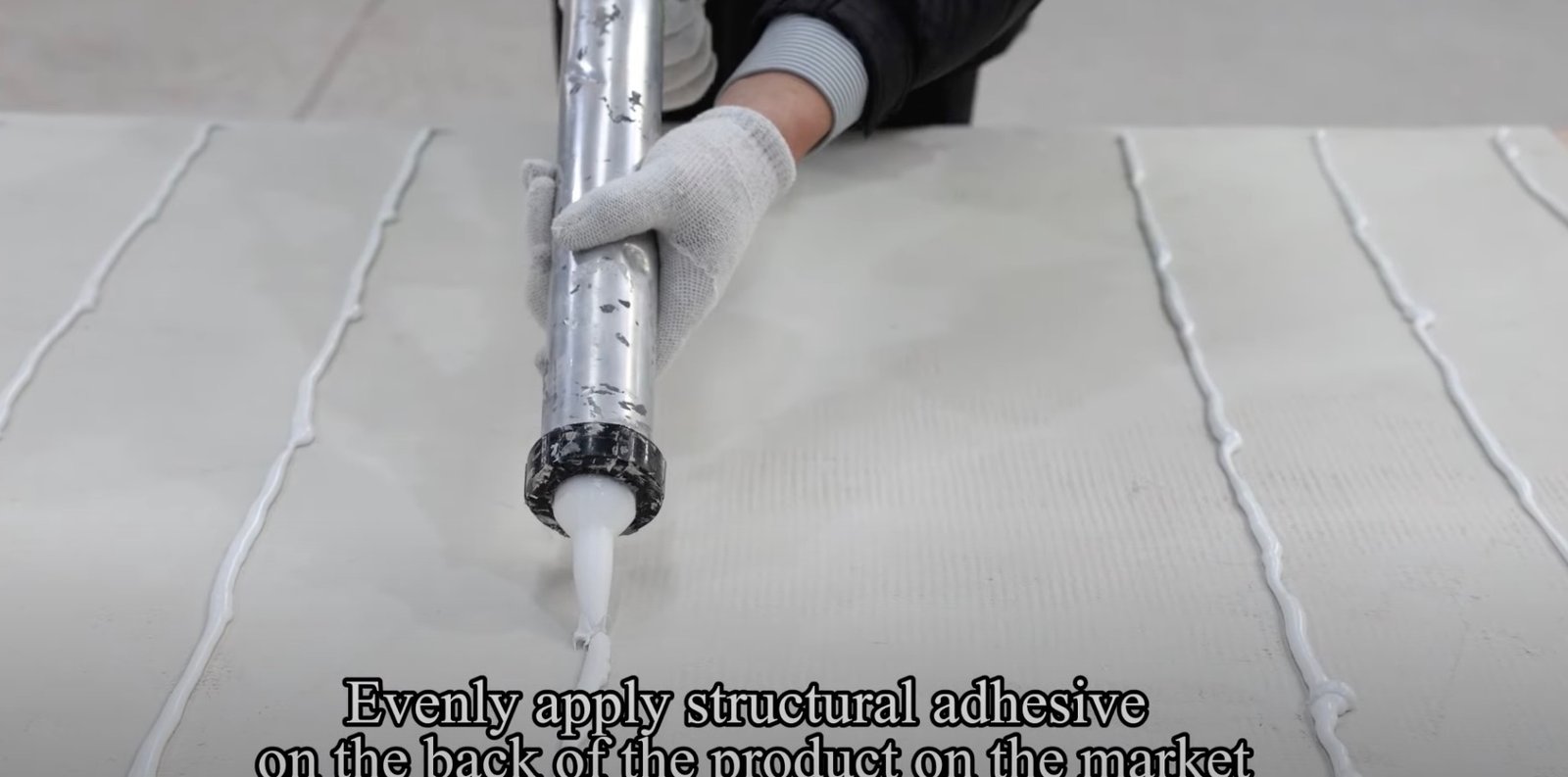
That has a second consequence people miss. Because the sheet conforms, the adhesive ridges and their collapse have to be verified by transfer — lift a sheet after setting and read what came off on the back. On a rigid tile you can sometimes get away with a skimpy bed; on a flexible sheet the same bed is a future hollow. Our guide to back-buttering and coverage covers that verification method in detail; the point here is that the adhesive choice and the application method are one decision, not two.
What actually differs between adhesive families?
Buyers do not need a chemistry degree; they need to know which questions separate the families. Four questions do most of the work.
- Is it formulated for a flexible, mineral-faced sheet? A product approved for MDF or foam board is not automatically right for a stone-powder face over mesh. The approval that matters is the one naming this class of material — flexible stone, MCM or soft stone — in writing.
- What is the open time, and does it match the crew’s pace? A fast-grab product that skins over before a large sheet is positioned is the wrong product regardless of bond strength. This is a question for the manufacturer’s data sheet, not the label.
- Does it stay flexible, or does it harden rigid? The sheet and the wall move. An adhesive that sets into a rigid shim transfers that movement to the face. A permanently flexible bond line tolerates it.
- Is it rated for the exposure? Interior dry wall, wet rooms and exterior facades are three different environments. A product cannot be assumed across them.
Notice what is not on the list: price per unit and “strongest bond” claims. Bond strength beyond what the system needs buys nothing; the wrong family at high strength is still wrong.
How does the substrate drive the choice?
The adhesive bonds to two surfaces, and the weaker one governs. Drywall, cement board, render, plywood and painted surfaces each absorb, resist or contaminate adhesion differently, and a product that performs on cement board may not be approved over a dusty render or a painted surface that was never meant to receive anything.
This is why the substrate check comes before the adhesive order. A wall that is not flat, sound and clean will defeat any adhesive, and a painted or sealed surface may need preparation or a different product entirely. Our guide to flexible stone over EIFS and render works through what a soft substrate demands before cladding is even discussed. The rule that travels: the adhesive approval names the substrates it covers, and a substrate outside that list is a question to the manufacturer, not a site improvisation.
What changes in a wet room or an exterior?
Water changes the failure mode, not just the risk. In a dry interior a marginal bond shows up as a hollow or a lifted edge. In a wet area water travels the void, so the same marginal bond becomes a leak path behind the finish. The adhesive in a shower or wet zone must be part of a waterproofed assembly: compatible with the membrane, rated for permanent damp, and applied over a system that is already tanked — the sequence is set out in our wet-room detailing guide.
Exterior work adds temperature movement and freeze-thaw where climates demand it. The bond line has to tolerate cyclic movement for years, which pushes the choice further toward products engineered to stay flexible, and the whole build-up — substrate, adhesive, sealant at edges — has to be treated as one system. An exterior wall is also where “the same adhesive as inside” most often fails, because interior products are simply not rated for the exposure.
What does a manufacturer’s approval actually tell you?
An approval is a set of conditions, not a compliment. When a supplier approves an adhesive for its flexible stone, read what the approval covers: which substrates, which exposure class, which application method and notch, and whether the sealant at edges is part of the tested system. The same product can be approved for interior drywall and explicitly excluded from wet zones, and the exclusion is usually in a note, not the headline.
This is also where the one-stop supply question belongs. Flexible stone systems ship with matched components — the panel, the adhesive and the sealant tested together. Buying the panel from one source and the adhesive from a hardware shelf means nobody has tested that pair, and if the bond fails, the panel supplier and the adhesive maker each have a defense. Matched components remove that argument; they are worth asking about at quotation stage, the same way you ask about samples and certification.
How do you prove the bond before committing the wall?
Run the sequence the manual implies, on a small area first, before the field goes up:
- Prepare the substrate to the approved condition — flat, sound, clean, and primed if the system calls for it.
- Apply the adhesive to the specified method and notch, on a day within the stated temperature range.
- Set two or three sheets in an inconspicuous place, pressing from the centre out to drive ridges into full contact.
- Lift one before the adhesive cures and read the transfer on the back. Full wet contact is the pass; channels and dry patches mean the method, the timing or the product is wrong.
- Only then lay the field, and keep a photographed record of the transfer test with the batch paperwork.
The lift test costs one panel and ten minutes. A hollow wall found at handover costs the whole elevation. This is the same evidence discipline that protects a buyer through inspection and COA checks — what you can show, not what you assumed.
What are the failure modes that trace back to adhesive selection?
Most callbacks on flexible stone walls arrive in one of three costumes, and each points back to a selection error rather than bad workmanship. Hollow-sounding panels within the first year usually mean the ridges never collapsed — an open-time or notch mismatch, not a lazy installer. Edge lifting at joints and corners traces to a bond line that hardened rigid and could not follow the movement the thin sheet passed into it. Wet-area delamination, the expensive one, is almost always an interior-grade product that met water, or a wet-rated adhesive applied over a tanking system it was never tested with.
The common thread is that none of these show up on the day of installation. Everything looks perfect at handover; the wall files its complaint months later, after the adhesive has cured to its final character and met its first season of movement. That delayed feedback is exactly why the selection decision deserves the same written discipline as the coverage check — when the failure appears, the question “which product, approved by whom, for which exposure” should have a documented answer.
FAQ
Can I use the same adhesive indoors, in wet rooms and outside?
Not automatically. Exposure class is part of the approval: interior, wet-zone and exterior use are different conditions, and a product approved for one may be excluded from another. Check the data sheet for the specific exposure before ordering, and ask the supplier to confirm in writing for the zone you are cladding.
Does a stronger adhesive mean a better wall?
No. Bond strength beyond what the system needs adds nothing, while the properties that actually matter — flexibility over time, open time suited to the crew, compatibility with the substrate — are separate. Choose the family that matches the sheet and the exposure, applied to the specified coverage.
Who is responsible when panel and adhesive come from different suppliers?
Whichever fails, the other has a defense, because the pair was never tested together. Matched system components remove that gap. If the project forces mixed sourcing, get written confirmation from the panel supplier that the proposed adhesive is acceptable for their product and exposure.
Is primer needed?
Some substrates need preparation and some products need a primer — it depends on both, and the answer is in the system documents, not a general rule. Skipping a specified primer to save a step voids the logic of the approval that was relied on.
What one check catches most adhesive mistakes?
The lift test on the first sheets. It exposes open-time errors, wrong notch, skinned adhesive and dirty substrates in one go, while they are still cheap to fix.
Adhesive guidance for a specific project should always be confirmed against the system’s installation manual and the manufacturer’s data sheet; the standards bodies behind adhered finishes, such as the Tile Council of North America, publish the reference methods installers work to. Format and thickness options for the sheet itself are on the flexible stone veneer page.