Cold-Climate Homes
Exterior cladding for homes in northern and mountain regions that must survive harsh winter cycling.

Flexible stone veneer engineered to survive repeated freeze-thaw cycles, sub-zero temperatures and ice-dam moisture. Specified for cold-climate homes, mountain lodges, northern commercial buildings and any facade exposed to frost and winter cycling.
Freeze-thaw cycling is the single most destructive force on a facade. Water gets into pores and joints, freezes, expands and pushes. Cycle after cycle, the skin cracks, spalls and delaminates – and ordinary cladding is the first thing to fail.
Water that seeps into a porous surface expands on freezing, driving cracking, spalling and progressive surface loss.
Some materials turn brittle at low temperature, cracking under impact or thermal movement in deep winters.
Ice dams and snowmelt push moisture into the wall assembly, freezing behind the skin and lifting it from the substrate.
Large temperature swings between winter and summer create thermal movement that stresses rigid cladding systems.

Flexible stone veneer is built around a low-water-absorption mineral surface that stays dimensionally stable through hundreds of freeze-thaw cycles. Lightweight and flexible, it moves with thermal changes instead of fighting them.
Engineered to withstand repeated freeze-thaw cycling without spalling, cracking or surface deterioration.
Very low absorption means less water in the surface to freeze and expand, so frost stress stays low.
The material bends and flexes with thermal movement, reducing the rigid cracking common in cold-climate cladding.
Around 80% lighter than natural stone, adding little dead load to cold-climate structures already carrying snow and ice.
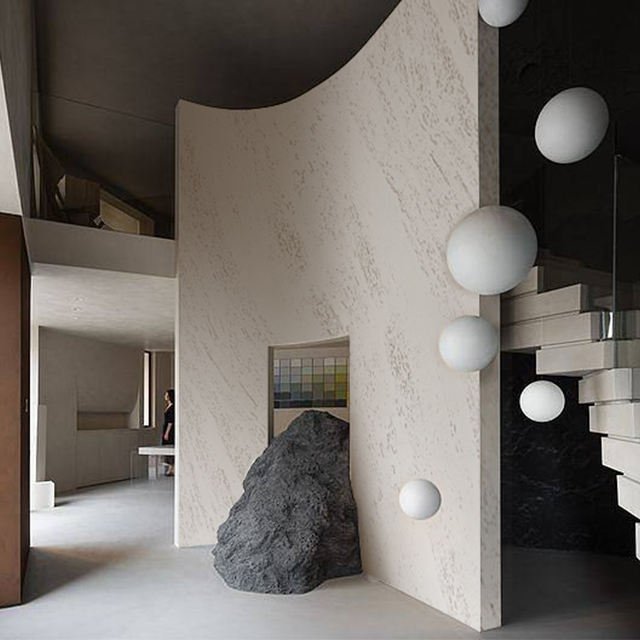
The properties that matter when you specify facade cladding for freeze-thaw and sub-zero environments.
Resistant to repeated freeze-thaw cycling, helping to prevent spalling and surface loss in cold climates.
Very low water absorption, limiting the moisture trapped in the surface that expands on freezing.
Around 5-5.5 kg/m2 – about 80% lighter than natural stone, easing load on cold-climate wall assemblies.
A-class fire performance, with ASTM E84 Class A documentation available to support your cold-climate code package.
Where flexible stone veneer earns its place in cold and northern building.
Exterior cladding for homes in northern and mountain regions that must survive harsh winter cycling.
Durable, low-maintenance facades for resort projects in alpine and high-latitude settings.
Cladding for cold-climate commercial and retail buildings that cannot afford seasonal facade repairs.
Yes. It is engineered with very low water absorption and a dimensionally stable mineral surface, so it resists repeated freeze-thaw cycling without spalling or cracking.
Yes. It stays flexible rather than brittle at low temperature, moving with thermal changes instead of cracking under stress.
Water expands on freezing. Very low water absorption means less moisture is trapped in the surface to expand, so frost-driven stress remains low.
No. The surface resists freeze-thaw spalling and surface loss, with accelerated cycling and aging tests supporting a long service life in cold climates.
Yes. It performs as a low-maintenance skin where snowmelt and ice dams occur; correct detailing at joints and penetrations keeps the wall assembly protected.
Yes. Lightweight and frost-resistant, it suits cold-climate homes, lodges and resorts while keeping dead load on the structure minimal.

Send us your facade spec and local climate details. We confirm freeze-thaw suitability, supply a sample for approval, and quote with your project MOQ.