
On paper, flexible stone is a finish trade with a delivery date and a fixing date. On site, it is a sequence problem: the panels arrive when the container arrives, they can only go onto a wall that is flat, dry and services-complete, and every trade after them will lean on the finished surface if given the chance. The walls that come out well are not the ones with the best installer — they are the ones whose programme put the stone where it belongs in the sequence and protected it after it was there. This guide covers how to schedule flexible stone delivery and installation around the other trades on a fit-out: the position it needs in the sequence, the interfaces that must be agreed in advance, and the holding points that keep the programme honest.
Where does flexible stone sit in the trade sequence?
The short answer: late, but not last. The stone needs a completed substrate — flat, dry, board joints treated — which puts it after framing, boarding and the first fix of every service that lands on its walls: sockets, spurs, duct terminations, backing for screens. It needs to be before the trades that would find it easier to work against a finished stone wall than against a boarded one: joinery surrounds, slat arrays, signage, glazing trims. And it must be protected through paint, floor finishing and final clean, the three trades most likely to damage it.
The failure signature of a wrong sequence is easy to recognise. Stone going on before services are first-fixed means panels cut open afterwards for boxes — every reopening is a visible patch. Stone going on before the substrate is signed off means the substrate’s sins become the finish’s defects. Stone going on last of all, squeezed into the final week, means corners cut at exactly the moment quality matters most. The slot is narrow and it is worth defending in the programme meeting, not discovering in the site hut.
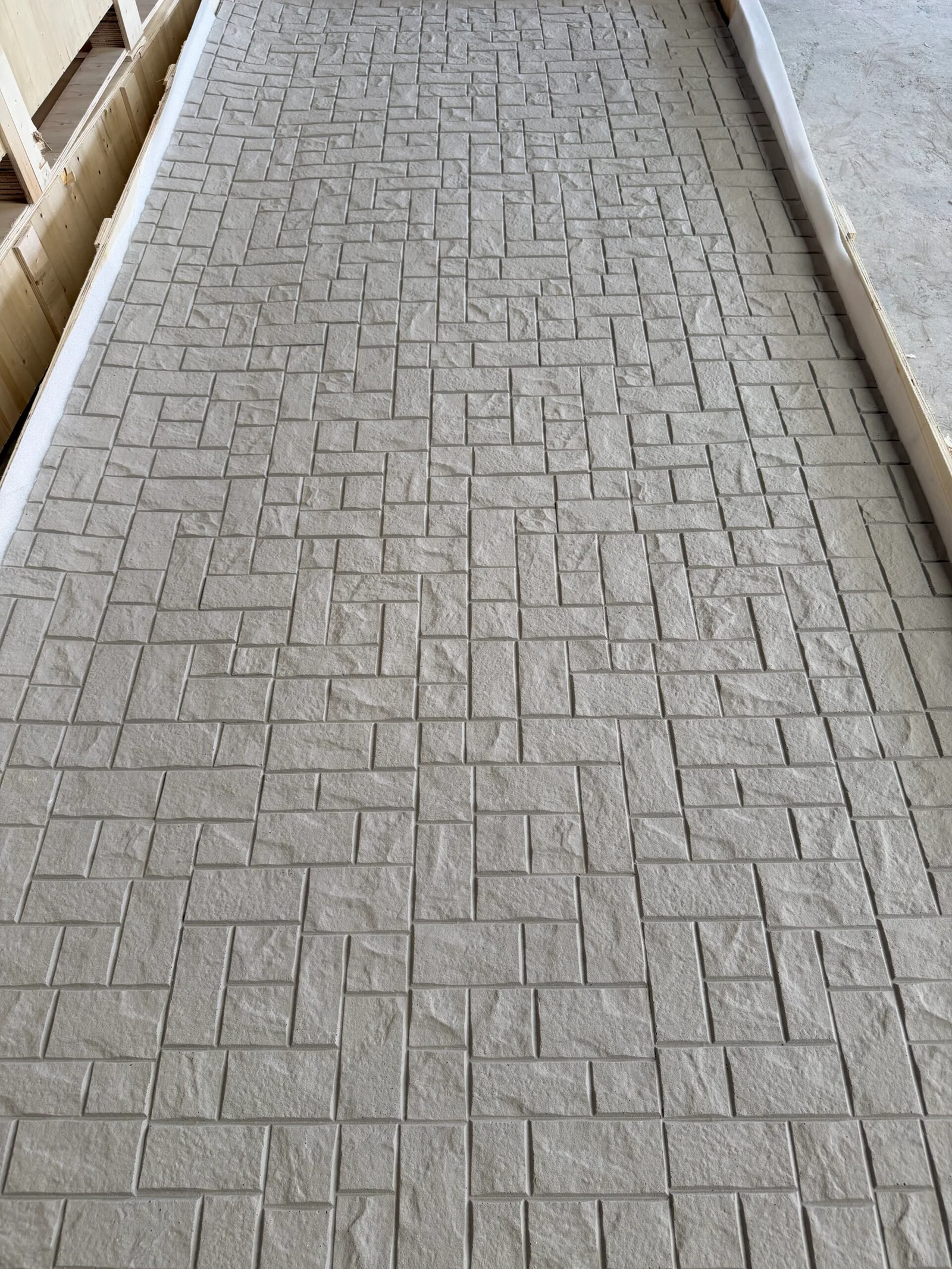
What has to be agreed with each neighbouring trade?
- Electrical and mechanical. Every box, spur and duct termination on a stone wall is first-fixed, tested and set to finished depth before cladding starts — the division of responsibilities our socket finishing guide draws at the box. Their sign-off is the stone trade’s green light.
- Boarding and framing. The substrate arrives flat and sound, with joints treated per the backing-board logic in our substrate guide, and its acceptance is recorded — photograph, straightedge pass — so the handoff is provable later.
- Joinery and slat arrays. agreed datum and sequence: stone first, timber second, with the junction detailed as our stone-to-timber guide sets out. Joinery datum comes off the finished stone face, agreed before either trade starts.
- Glazing and storefront. The stop-line zones from the curtain-wall drawings decide where stone may run — the coordination exercise covered in our transition guide.
- Painting and floor finishing. Both work after the stone, so their protection duty is contractual: sheeting, tapes tested on a spare panel, no solvents stored against the wall.
Each of those agreements is a line in the programme with a name against it — not a relationship, a line. The walls that survive a fit-out are the ones where “who owns this interface” was answered in a meeting room.
How should delivery be scheduled against installation?
The container date and the fixing date have to be planned as one decision, not two. Panels arriving months before the wall is ready sit in storage — and storage is not free of risk: the material needs to stay flat, dry and temperature-stable, per the handling rules in our protection guide. Panels arriving after the wall is ready put the finish trade into programme compression, which is when open times get stretched and coverage gets thin. The lead-time maths that links order date, production window and fixing window is laid out in our lead time and scheduling guide; the point here is that the fixing date drives the order date, not the other way round.
Two holding points keep the delivery honest. First, the pre-shipment inspection: the batch is checked and photographed before it loads, so a tone or relief problem is found while it is still the supplier’s, per the inspection and COA logic. Second, the arrival check: packaging, batch marks and damp inspection at unloading, the routine our damp packaging guide describes. Between them, the material arrives proven, and the programme argument stays about dates rather than quality.

What does the installation window itself need?
Three conditions turn a fixing window into a quality window. Access and lighting: the wall fully available — no scaffold strikes mid-field, no stored materials in front — and lit well enough to read tone and joints, which is also the light the wall will be judged under. Temperature inside the stated range for the adhesive system, which on a fit-out means the permanent heating may need to run earlier than usual, an argument worth having in October rather than on the day. Uninterrupted days: a field goes up faster and better when the same crew keeps continuity; every split wall pays a small joint-alignment tax.
Add the internal sequence of the wall itself: set-out confirmed and marked, mock-up accepted, then areas completed in the order that keeps walking routes off finished panels. The daily routines — first-sheet lift test, end-of-day hollow scan — slot into the same rhythm, per our installer training guide.
How is the finished wall protected for the rest of the programme?
Protection is a scheduled activity with an owner, not a reaction. The standard package: rigid sheeting over high-risk walls, edge protection at corners and reveals, plates fitted to sockets late, and a named person whose job includes checking the protection weekly. The walls that get damaged are almost never the ones nobody protected — they are the ones whose protection was put up once and never revisited while three trades worked around it.
One more schedule line matters: the completion scan. Before handover, the wall gets its tap-test, joint check and photography — the acceptance routine from the submittal discipline — while there is still time to fix what it finds. A programme that leaves that scan out has not finished the stone package; it has only stopped working on it.
How does the sequence change on a phased or occupied fit-out?
Occupied and phased jobs break the tidy “late but not last” rule, because there is no “last”. The adaptation that works is the zone package: each phase gets its own mini-sequence — substrate sign-off, services first fix, stone, protection, handover of that zone — and the boundaries between phases get detailed like any other junction. A stone field crossing a live phase line is a wall that gets worked on from both sides; better to stop it at a designed joint, cover the boundary with its own termination, and let the next phase pick up from a drawn line rather than a negotiated one.
Phased work also multiplies the delivery problem. Split shipments sound like the answer and often are, but each shipment is its own batch logic: the panels for phase two are matched to the approved sample at their own pre-shipment check, and the boundary between phases is where a tone step would live if it were going to. The batch discipline from our batch consistency guide is the tool — applied per phase, not once per project.
Последнее правило поэтапной работы — защита не только для ремонтников, но и для будущих occupants. В работающем отеле или торговом зале ежедневный трафик сам по себе является механизмом износа, поэтому коридоры требуют ударной защиты на уровне тележки, а финальный скан-контроль каждой зоны проводится при её передаче, а не в конце проекта: сроки хранения доказательства стареют, и состояние стены должно быть таким же свежим, как и её покраска.
Часто задаваемые вопросы
Можно ли монтировать гибкий камень до того, как будет готова потолочная конструкция?
Как правило, да: стык камня с потолком проще выполнить аккуратно, если использовать потолочную сетку или финишный бордюр после установки камня. Но до этого момента должны быть завершены все инженерные коммуникации в этих же стенах и подписан готовый основанием.
Насколько поздней может быть поставка, чтобы не сорвать график?
Оптимальное время для монтажа начинается прямо перед окном монтажа; когда оно уже прошло — слишком поздно. Стена, готовая к панелям, но без панелей — это простой бригады; панели на объекте, но без стены — это риск хранения. Дата заказа рассчитывается backwards от окна монтажа, с учётом производственного окна поставщика.
Кто контролирует защиту в остальной период монтажа?
Тот, кого указывает график — обычно это установщик или руководитель отдела отделки генподрядчика. Проверка проводится еженедельно, реально и фиксируется письменно; лист защиты, который никто не проверяет, не является защитой.
Что делать, если график сдвигается после того, как панели уже прибыли?
Перепланируйте хранение с учётом правил транспортировки и повторно подтвердите окно монтажа до того, как изменятся условия для клея и основания. Не пытайтесь сократить монтаж, чтобы отыграть сдвиг — именно такое давление приводит к отслоениям и дефектам швов, по цепочке ответственности за которые мы проходим. failure-liability guide (см. пункт 9).
Планируйте последовательность сознательно, заранее согласуйте все интерфейсы и обеспечьте окну монтажа необходимые условия. Форматы и данные по обращению для графика указаны на странице; практика расстановки строительных бригад при монтаже публикуется такими организациями, как flexible stone veneer (см. пункт 11) Associated General Contractors of America.