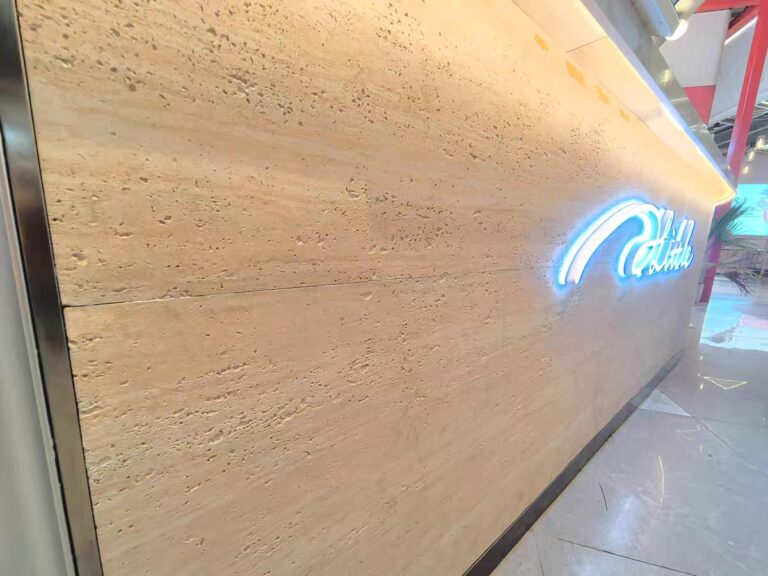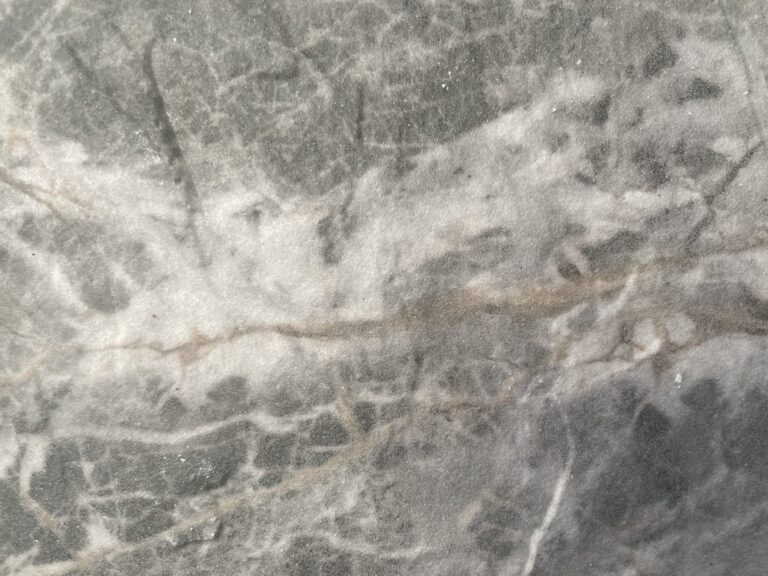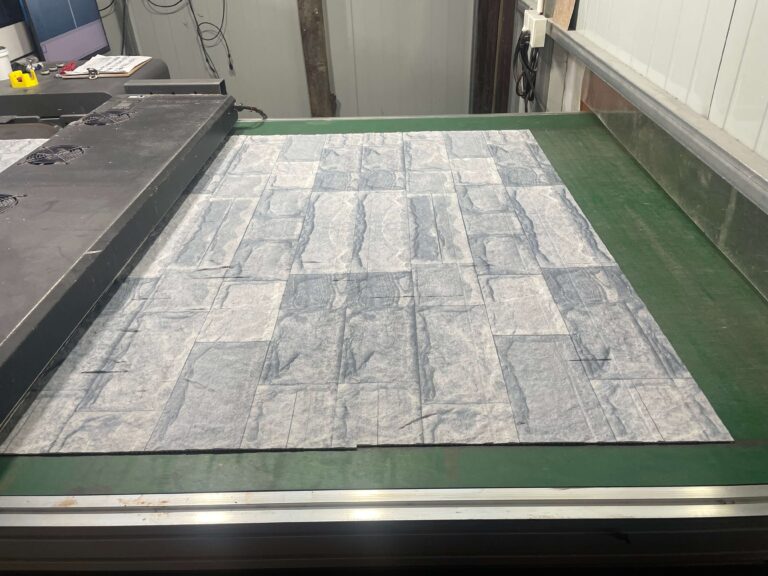
A flexible stone wall is finished twice: once by the installer, and once by whoever designs its light. The same travertine field that glows under a warm wall washer can look flat and grey under a single downlight, and the same slate that reads rich at night can turn harsh in the morning sun. Because the stone face is a printed, textured mineral surface rather than a glossy slab, it answers light differently from both paint and polished stone — it rewards grazing light that reveals relief, and it punishes hot spots that pool on a single panel. This guide covers how to light a flexible stone feature wall: colour temperature, direction, the difference between washing and grazing, and how the translucent panel changes the game entirely.
What does a textured mineral face want from light?
Two properties of the material drive every lighting decision. First, the face is matte and micro-textured — pores, stratification, cleave marks — which means it scatters light rather than reflecting it. That kills mirror highlights but makes the wall an excellent subject for raking light: light that arrives at a shallow angle skims across the relief and turns physical texture into visible shadow. Second, the colour is a printed layer, so its warmth or coolness is strongly influenced by the lamp’s colour temperature. Both properties mean the wall cannot be judged from a flat photograph under neutral light; it has to be lit deliberately to be seen at all.
The practical consequence: budget for lighting design as part of the wall, not as an afterthought. The most beautiful pattern in the catalogue, lit by whatever ceiling downlights the room happened to have, is a missed specification.
Wash, graze, or spot — which one, and where?
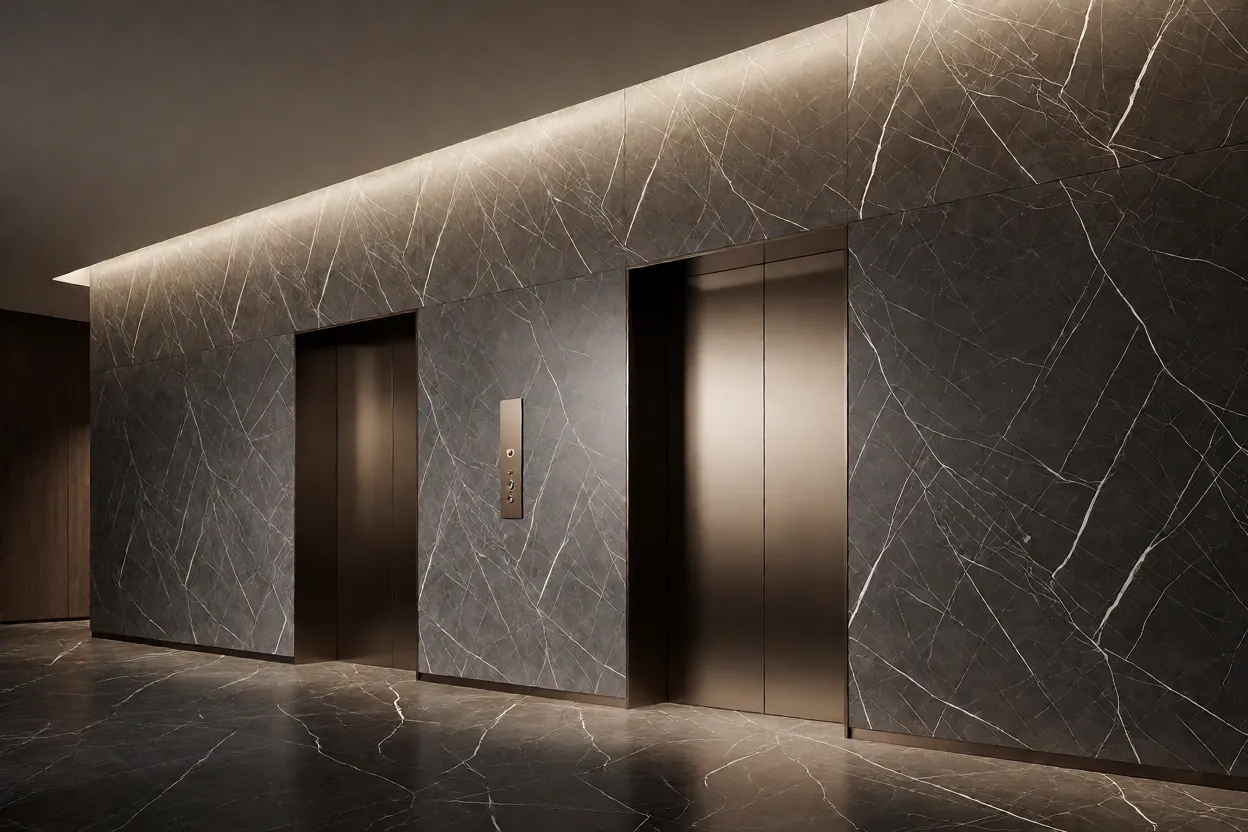
Three techniques cover most walls, and they are not interchangeable. Walling — linear fittings or a track washing the whole plane evenly — is the default for large fields and corridors: it presents the colour and lets the texture come second. Grazing — light placed close to the wall, aimed steeply down or across — is the drama option: it exaggerates relief, which is exactly right for deep-textured faces like rammed earth or slate, and exactly wrong for a wall with installation imperfections, because grazing light is also the light that reveals them. Spotting — narrow beams picking out objects or niches — belongs to the objects, not the field; a spot on bare stone produces a hot pool that reads as a mistake.
Choose by pattern depth. Fine travertine and marble-look faces, with shallow relief, want even washing and a comfortable viewing brightness. Deep slate, brick-look and rammed earth faces want grazing, placed so the shadow direction is consistent across the whole wall — two grazers from opposite sides cancel each other’s relief and leave the wall looking lit but flat.
Which colour temperature suits which pattern?
Colour temperature is the lever that moves the printed tone. Warm white (2700–3000 K) deepens travertine, rammed earth and wood-grain faces; it flatters hotel lobbies, restaurants and homes, and it makes warm neutrals feel expensive. Neutral-to-cool white (3500–4000 K) strengthens slate, grey and cool marble-look faces, and reads clean in retail, clinical and work settings — but pointed at a warm travertine it will grey the face and undo the pattern’s whole character. Mixing temperatures across one wall is the one unforgivable error: the eye reads the seam between lamps before it reads the stone.
Test with a lamp and a sample before specifying the circuit. Hold the physical sample of the chosen pattern under warm and then cool light at the wall’s real distance; the difference is often strong enough to settle the specification in a minute. The reference colorimetry behind this — how tone and illuminant interact — is published by the 국제조명위원회(CIE).
How are light lines integrated into the cladding?
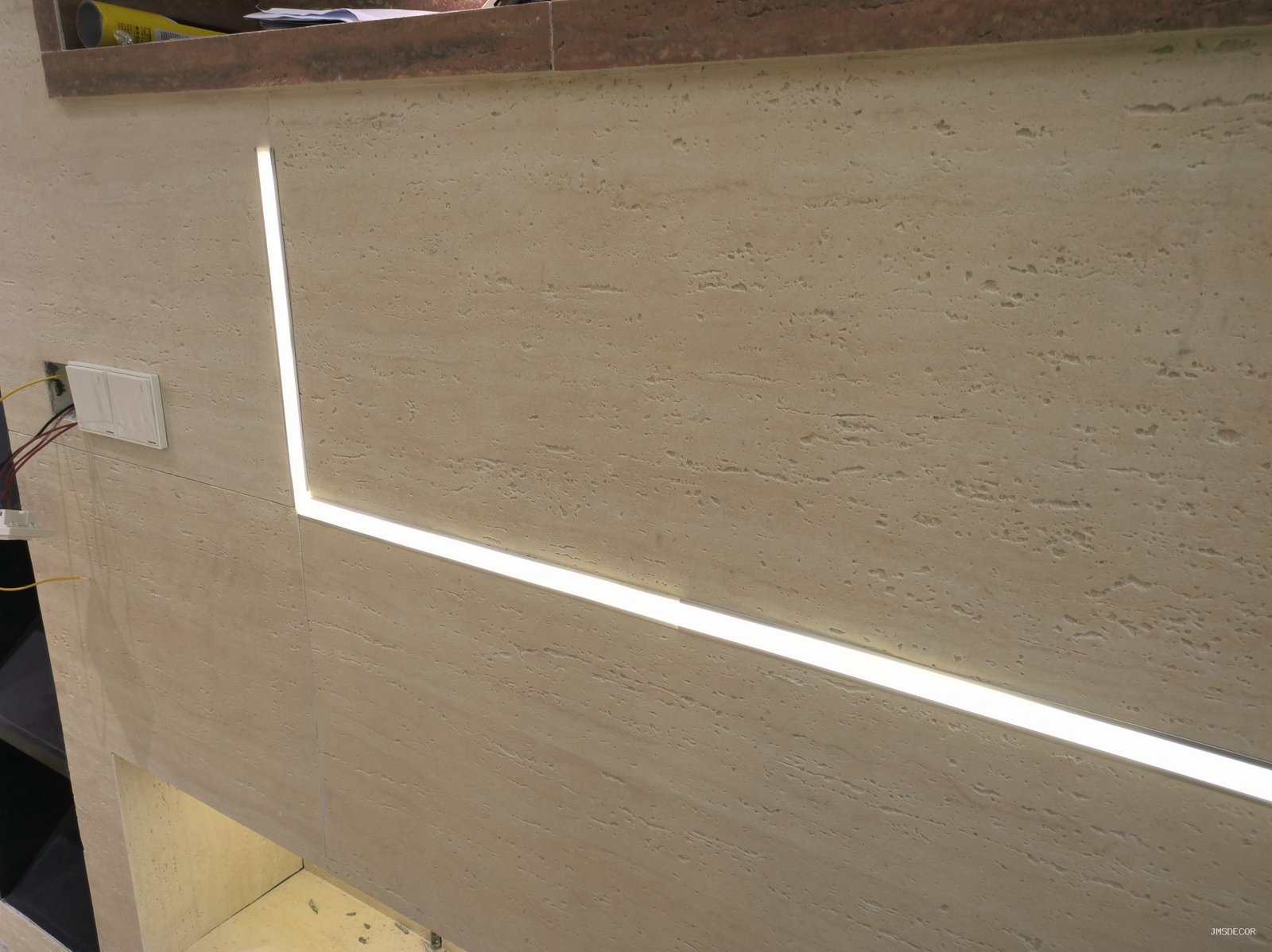
The trend detail of the last few years is the light line — a recessed LED strip that traces a joint, an edge or a reveal — and flexible stone takes it well because the sheet trims cleanly to a designed line. The integration questions are the same ones our socket and penetration guide covers for services: cut before bonding, protect the edge, and plan the driver and cable route behind the wall, not through the finished face. What lighting adds is a heat and maintenance consideration: an LED channel sealed into a stone detail must be reachable when the strip eventually needs replacing, so design the line as a removable profile or a channel with a diffuser that pulls out, not a glued-in strip behind a sealed edge.
Placement matters as much as the hardware. A light line under a horizontal termination reads as a floating detail — the standard trick above a half wall’s cap, which our top-edge capping guide treats in detail. A line traced along a vertical corner turns the junction into a deliberate feature and can replace a shadow gap entirely. A line around a niche does what the niche itself wants: it turns a recess into a display.
What changes with a backlit translucent panel?
Translucent flexible stone is a different lighting instrument. At around 2 mm it transmits light, so the stone is the diffuser: the pattern glows, the pigment reads as veined colour, and the wall becomes a light source rather than a lit surface. The craft questions shift to what is behind the sheet — an even light box, the spacing of the emitters, and the backing board’s colour, because any unevenness behind a translucent face shows immediately as blotch. A white, evenly spaced array with correct stand-off from the sheet is the difference between a premium glowing wall and a grid of visible dots.
The full method — light box design, seam layout, kerf behaviour at cut edges — is covered in our backlit panel installation guide. The point here is earlier: if the design wants a glowing wall, that decision belongs at pattern selection, not at fit-out, because a standard opaque face cannot be backlit later.
How much light does a stone wall actually need?
Enough to be seen, not so much that it becomes the room’s brightest object — unless it is meant to be. A feature wall usually sits a step above ambient: lit to be clearly the focal plane while floor and ceiling stay quieter. Practically, that means the wall’s average brightness should feel comparable to a well-lit work surface, with the evenness checked at night by walking the room: no visible scallops from downlights, no pooling at panel scale, no hot spots where a spot has strayed onto the field. Where the wall is also on camera — reception backdrops, retail — check it through the camera as well, because a wall that looks fine to the eye can stripe on a sensor.
- Walk the room at night and look for scalloping and pools from each fitting in turn.
- 한 평면의 모든 램프가 동일한 색온도를 공유하는지 확인합니다.
- 전체 면에서 그리저 조명의 음영 방향이 일관된지 확인합니다.
- 조명 라인을 교체하거나 유지보수할 때 석재 끝단(엣지)을 손상시키지 않아야 함을 확인합니다.
- 핸드오버 기록용 조명이 켜진 벽의 사진과 아래 가이드에 명시된 제출 문서 증거를 함께 촬영합니다. 제출 문서 가이드 에 대해 설명합니다.
벽이 곡선일 경우 조명 계획은 어떻게 변합니까?
곡선 형태의 플렉시블 스톤 벽 — 기둥 감싸기, 호 아치 리빌, 유려한 리셉션 데스크 — 은 이 소재의 핵심 매력을 가장 잘 보여주는 사례로, 조명 기하학에 두 가지 변화를 가져옵니다. 직선 벽은 일정한 이격 거리로 조명 기구 한 줄을 배치해 비출 수 있지만, 곡선 벽은 그렇지 않습니다. 천장 고정형 조명에서 표면까지의 거리가 프로파일 주변으로 달라지기 때문이며, 거리가 멀어질수록 조도(빛의 강도)는 급격히 떨어집니다. 조정 없이 설치할 경우 발생하는 문제는 이미 익숙합니다: 상부는 과다 노출되고 측면은 어둡게 흐려지는 현상입니다. 해결책은 두 가지입니다. 첫 번째는 조명 소스를 곡선에 따라 배치하는 것(코브 조명, 프로파일에 맞게 구부린 트레크, 곡선 에지를 따라 추적되는 라이트 라인 등)이고, 두 번째는 곡선으로부터의 거리를 충분히 멀리해 거리 차이에 따른 광량 variation을 무시할 수준으로 낮추는 것입니다.
두 번째 변화는 곡선에 그리저 조명을 비추면 relief 효과가 불균등하게 증폭된다는 점입니다. 그리저 쪽 면은 깊은 그림자를 생성하는 반면, 반대쪽 면은 평평하게 보입니다. 강렬한 곡면 작품에서는 그리저 조명 대신continuous한 확산 조명(wash)으로 대체하는 것이 일반적이며, 드라마틱한 효과는 곡선 형태 자체에 맡깁니다. 이 원리는 당사의 곡선 벽 설치 가이드에서도 동일하게 적용됩니다 — 형태에 조명하고, 질감은 자연스럽게 맡기십시오.
자주 묻는 질문
플렉시블 스톤 벽은 잘 보이려면 전용 조명이 필요합니까?
계획적인 조명이 필요합니다. 실내 일반 조명 아래 있는 벽은 질감이 있는 페인트 벽으로 인식되지만, 동일한 벽에 그리저 조명 하나나 균일한 wash 조명을 비추면 석재로 인식됩니다. 그 차이는 소재가 아닌 설계에서 비롯됩니다.
따뜻한 색온도(CCT)와 차가운 색온도 중 어느 것이 석재에 더 적합합니까?
램프 색온도를 패턴 계열에 맞게 선택하십시오: travertine, rammed earth, 우드 무늬 표면에는 따뜻한 백색(Warm White), 슬레이트, 그레이, 시원한系统的 marble 무늬 표면에는 중립백색(Neutral White)을 사용합니다. 동일한 평면에서 색온도를 혼용하지 마십시오.
그리저 조명은 설치 결함을 드러낼까요?
네 — 그것이 그리저 조명의 본질입니다. 질감의 표현 효과가 리스크를 상쇄하는 deep-relief 패턴에 그리저를 사용하고, 그리저의 방향을 일관되게 유지하며, 핸드오버 전에 그리저 조명으로 벽을 점검해 결함이 고객 아닌 시공사 쪽에서 발견되도록 하십시오.
Can I retrofit a light line into an existing stone wall?
Usually not cleanly. The recess needs a cut and a profile, which is a cladding-stage decision. If a light line is possible in the design at all, plan it before the sheets go up.
Light the wall as part of designing it: choose technique by pattern depth, temperature by pattern family, and integrate lines at cladding stage. Pattern and format options are on the flexible stone veneer page; worked wall examples live in our design ideas.