The desert cladding MCM decision — modified clay material versus metal versus concrete — rarely turns on appearance. It turns on what each material does after two years of 48°C afternoons, abrasive airborne silica, and a hard thermal cycle every single day. Ask any project team why a facade that looked flawless in the sample room failed on the south elevation two summers later, and the answer usually sits upstream: a specification written for a temperate climate and never re-validated for the Gulf. For a full overview of our решений по гибкой каменной облицовке, start with the main site.
When you are sourcing for Dubai, Abu Dhabi, or Dammam, the MCM versus metal versus concrete conversation has to start with punishment. August ambient temperatures in the Gulf routinely exceed 45°C, and dark, low-reflectivity cladding surfaces can climb well past 80°C in direct sun. That is not simply uncomfortable to touch. It is thermal expansion cycling every day, sand particles travelling at 40 km/h or more during shamal season, and ultraviolet exposure that degrades any unprotected coating. Three different suppliers can all label a product “UV-resistant” and “suitable for hot climates” — and only some of those claims hold up after real desert exposure. If this is your first comparison, our Сравнение материалов guides cover the underlying criteria in more depth.
The sample approval stage is where most procurement teams make the wrong call. They evaluate colour and texture at 22°C in an air-conditioned office, then sign a specification that will never see those conditions again. What you actually need to verify is how the material behaves at 65°C, how it tolerates the afternoon-to-midnight swing, and whether its fire rating still stands after surface degradation. For flexible stone panels, the ASTM E84 Class A rating is a property of the core material rather than a surface coating, and the 3D inkjet-printed finish sits inside the material matrix instead of on top of it. Metal panels carry a different risk profile: a reflective or low-reflectivity skin still drives heat gain, and the expansion joints that long runs require add installation complexity that shop drawings often gloss over.
Concrete cladding appears on a lot of Gulf specifications because it feels solid and traditional. The problem nobody raises in the value-engineering meeting is weight. A precast concrete panel system adds so much dead load that the structural steel needed to carry it can erase any saving on the material itself. For a high-rise tower, the kilogram-per-square-metre maths shifts the whole budget. Lightweight mineral panels clocking in at 1.5–6 kg/m² change the steel tonnage calculation before the foundation is even poured. A working benchmark for your next supplier call: if a cladding system weighs more than 10 kg/m², ask for a structural load recalculation against a lightweight alternative. If the supplier cannot produce it, that tells you something.
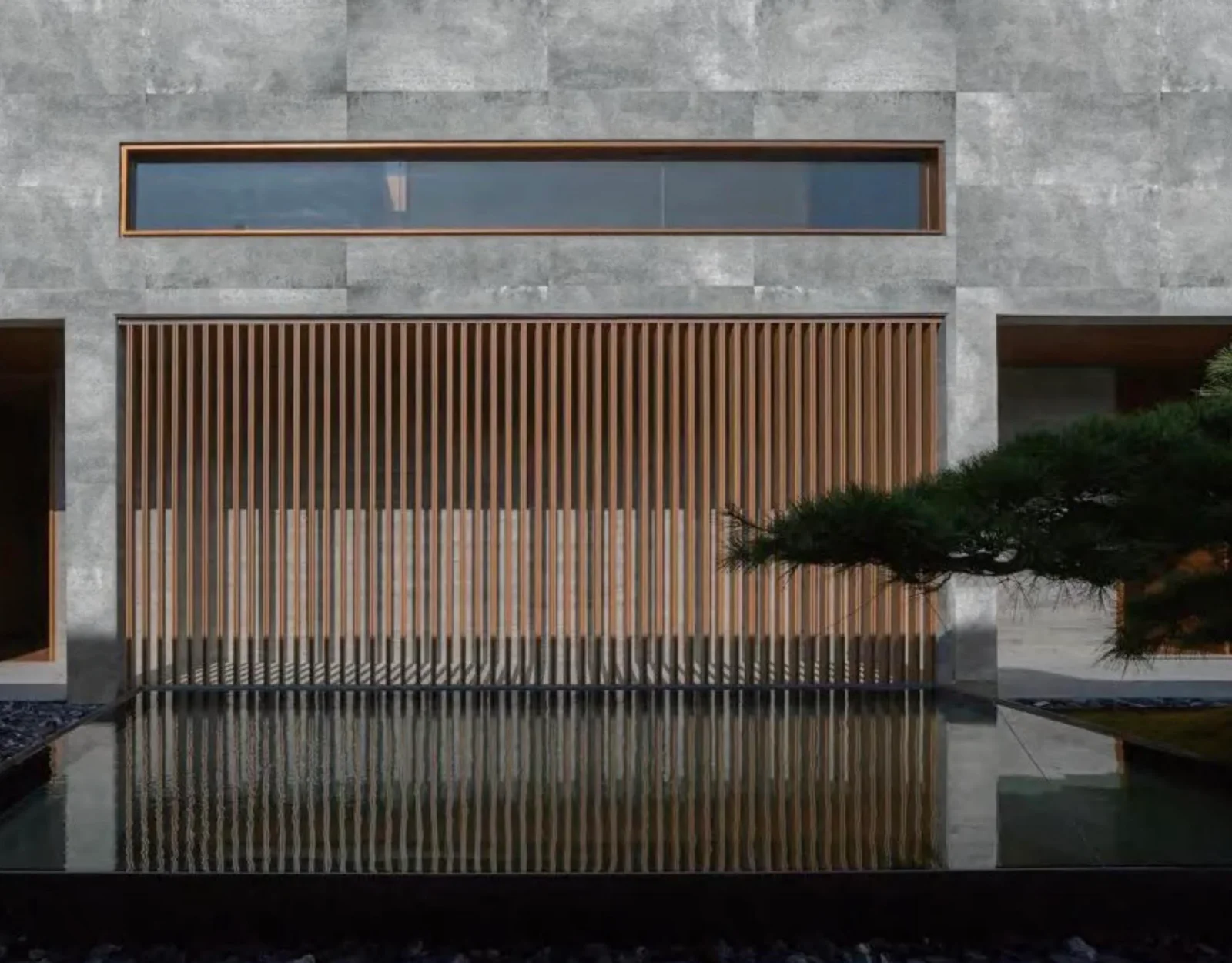
What Desert Heat Does to Cladding Materials
In the Gulf, cladding is not decoration — it is the first line of defence against extreme surface heat and airborne silica.
Anyone who has done a punch-list walk in August knows the difference between a spec sheet and reality. The gap shows up quickly: sealant joints that cured brittle in the sun, powder coating that chalked, and a facade that radiates heat like a storage heater long after sunset. Desert conditions do not just test materials — they expose weak specification logic.
The failure mode most consultants miss is not a dramatic structural collapse. It is cumulative micro-degradation that erodes the asset’s value over several years — damage you will not see inside the first warranty period. By the time it is visible, the owner is looking at a full re-cladding line item in the capex forecast, and the original installer is long gone.
- Thermal Shock Cycling: A dark metal panel can reach 80°C at 2 PM and drop toward 25°C by midnight. That roughly 55°C daily swing works the joints and fasteners far harder than most temperate-climate test regimes ever simulate.
- UV-Catalysed Breakdown: Desert UV indexes regularly exceed 11. Polymer-based finishes that pass standard accelerated weathering can still show colour shift and chalking under the combined effect of UV plus daily sand abrasion that a lab chamber never reproduces.
- Sand Impingement Erosion: A shamal wind event carries silica particles at 40–60 km/h — effectively low-pressure sandblasting. Anodised and coated aluminium finishes lose their cosmetic layer, and the real cost is not the material but the access equipment and downtime to replace a section high on a tower.
What makes this harder is that most comparison data sheets come from temperate-climate testing labs. A material that performs brilliantly in a Florida UV chamber or a German freeze-thaw rig has not been validated for the combined assault of Gulf heat, humidity shift from air-conditioning venting, and abrasive airborne particulates. If the supplier cannot show you test data from a hot-arid exposure site, you are the one running the field test on your client’s building envelope.
The thermal-mass trap catches specifiers off guard. Heavy concrete or stone cladding absorbs heat all day and re-radiates it into the building and the surrounding microclimate all night, which raises cooling demand. Lightweight modified clay material (MCM) panels at 1.5–6 kg/m² do not store meaningful thermal energy, so the building cools down once the sun sets.
The smart money in Gulf projects has shifted toward asking one question before any aesthetic sample gets approved: “Show me five installations in the region that are past their third summer.” If the supplier cannot produce that reference list with contact details, the specification discussion should pause there.
| Материал | Thermal Expansion | UV Resistance | Sand Abrasion | Heat Island Effect |
|---|---|---|---|---|
| Flexible Stone (MCM) | Minimal effective movement; resin-bonded polymer and glass-fiber matrix absorbs stress | 3D inkjet printing with UV-stable inorganic pigments embedded in the material, not a surface coating | Flexible surface deflects particle impact instead of chipping or exposing bare substrate | Low thermal mass; lightweight panels add little dead load and store little heat |
| Metal Panels (Aluminum/Steel) | High expansion rate; panels can warp or buckle at seams under desert heat and need expansion joints | Coating fade is common; PVDF finishes slow it but add cost | Susceptible to scratching and coating damage from wind-driven sand | Surface temperature can exceed 80°C; contributes to urban heat gain |
| Precast Concrete | Moderate expansion; mass resists quick swings but micro-cracks develop over repeated cycling | Colour fading is minimal, but surface dusting and efflorescence can increase under UV | Good abrasion resistance, though surface pitting can occur over decades | High thermal mass absorbs heat and re-radiates it at night |
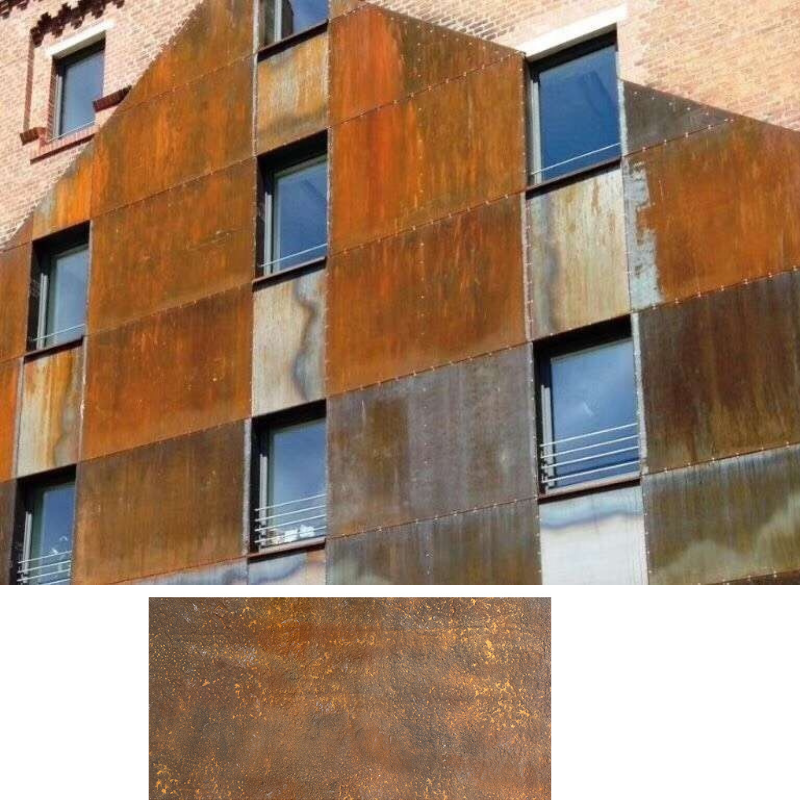
Comparison Criteria
In desert projects, cladding fails from combined thermal shock, UV degradation, and sand abrasion — rarely from a single factor.
Procurement teams routinely choose facade materials from a single spec-sheet number, only to face spalling, colour fade, or panel warping within a couple of years. The four criteria below are what actually determine whether a cladding survives a long service life in extreme heat and sandstorms — or becomes a warranty claim.
- Thermal Expansion: Aluminium moves roughly 23 × 10⁻⁶ per °C, so a long panel run generates measurable movement between a hot afternoon and a cool night; without proper joint design, panels buckle or fasteners shear. Concrete expands less but cracks under thermal cycling if the substrate is not decoupled. Modified Clay Material (MCM) flexible stone stays dimensionally stable because its resin-bonded matrix absorbs movement rather than transferring it, which removes one common source of call-backs on tall buildings.
- UV Resistance: Standard coil-coated metal loses gloss over a few years under intense Gulf sunlight, and PVDF coatings slow rather than stop the process once sand abrasion erodes the film. Concrete pigment is inherently UV-stable but limited in palette, and its surface can dull or effloresce. MCM flexible stone uses 3D inkjet printing with UV-stable inorganic pigments cured into the material, so colour holds even when the surface texture is lightly sand-worn.
- Sand Abrasion Resistance: Metal facades in open desert pit quickly, and once the coating is breached, corrosion accelerates in coastal zones. Concrete is harder but its cement paste erodes over time, exposing aggregate and trapping dust. MCM flexible stone absorbs particle impact through its flexible polymer structure instead of chipping, so a wind-driven sand event leaves no exposed bare substrate to corrode.
- Installation Cost: Desert construction labour is not cheap. Metal panel systems need sub-frames, precise cutting, and crane time; precast concrete is heavier still and needs larger cranes and additional structural steel. MCM soft stone weighs 1.5–6 kg/m² and installs with direct adhesive on prepared substrates, so a small crew can cover wall areas without mechanical fixing or heavy lifting — the labour and equipment saving, not the sticker price, is where the budget moves.
| Критерии | MCM (Flexible Stone) | Metal Cladding | Concrete Cladding | Desert Impact |
|---|---|---|---|---|
| Thermal Expansion | Resin-bonded matrix absorbs movement; panels stay stable under desert heat cycling. Lightweight (1.5–6 kg/m²) reduces structural load. | High expansion coefficient (aluminium ≈ 23 × 10⁻⁶/°C). Surfaces can exceed 80°C and require expansion joints. | Moderate expansion but high thermal mass absorbs and re-radiates heat. Heavy self-weight adds structural cost. | MCM avoids the thermal-stress cracking common in rigid materials. |
| UV Resistance | 3D inkjet-printed inorganic pigments embedded in the material matrix. ASTM E84 Class A core. | PVDF coatings offer good UV protection but can chalk; dark colours fade faster. | Inherently UV-stable but limited palette; surface may dull or effloresce. | MCM maintains colour fidelity in intense sunlight. |
| Sand Abrasion Resistance | Flexible surface deflects sand impact and absorbs abrasion without exposing a corrodible substrate. | Prone to scratching and denting; sandblasting effect erodes coating and can start corrosion. | Abrasion resistance depends on mix design; sand can erode the surface and expose aggregate. | MCM withstands sandstorms without protective films or frequent recoating. |
| Монтаж | Direct adhesive on prepared substrates; no crane, no sub-frame. Single-person handling of standard panels. | Requires sub-frame, lifting gear for large panels, and expansion joints. | Heaviest option; needs structural support, skilled crews, and long curing times. | MCM reduces labour, equipment, and programme time versus rigid systems. |
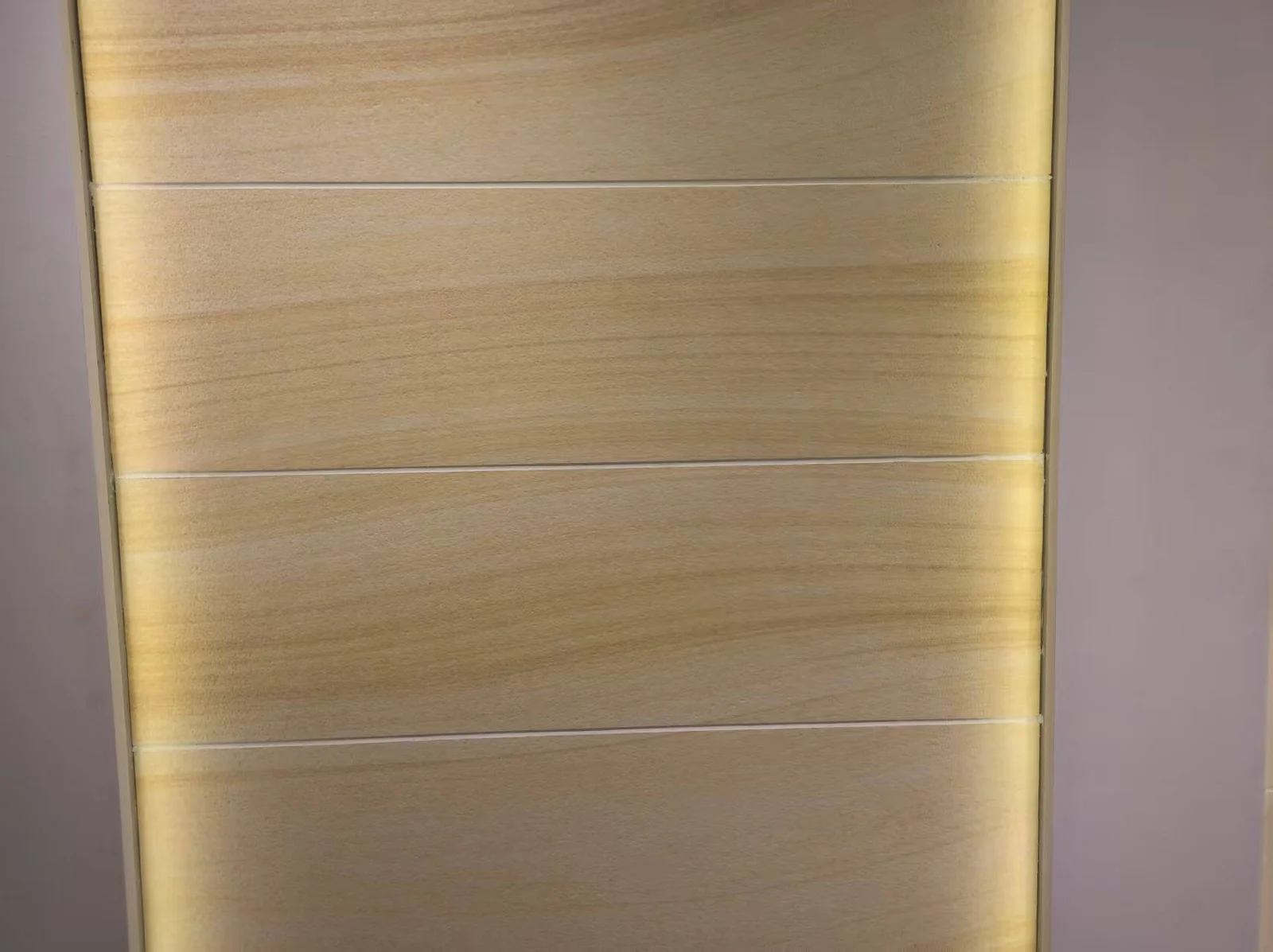
Flexible Stone (MCM) Performance Data
MCM combines an ASTM E84 Class A core with the flex and light weight that rigid cladding cannot match.
When evaluating exterior cladding for hot climates, three data points separate engineered flexible stone from decorative wallpaper: fire performance, UV stability, and structural load reduction. Developers targeting the UAE or Saudi markets need more than a spec sheet — they need properties that translate into lower cooling demand and faster installation. You can see the full flexible stone product range for the formats and textures referenced here.
- Fire Rating: ASTM E84 Class A (flame spread index ≤25, smoke developed ≤450). This meets the facade requirements for high-rise hotels and commercial towers in Dubai and Riyadh, where limited-combustible or non-combustible materials are mandatory above certain heights. JMS Decor panels also carry EN 13501-1 Class A2, which is the European equivalent used on many international specifications.
- UV Resistance: 3D inkjet-printed patterns use inorganic pigments cured under high-intensity UV lamps during production, so the colour sits within the material rather than as a coating that chalks off. The travertine or slate finish is designed to hold its tone through repeated Gulf summers instead of bleaching to chalk.
- Weight and Formats: 1.5–6 kg/m² across a 2–8 mm thickness range — roughly one-fifth the weight of natural stone at equivalent coverage. Standard panels are 1200×600 mm, with big boards up to 1200×2900 mm, and a minimum bend radius of about 200 mm for standard textures. Lower dead load directly reduces steel tonnage and foundation sizing in high-rise construction.
- Compliance and Quality: ISO 9001, ISO 14000, BSCI, and CE, backed by a manufacturing defect rate below 1%. Certified test reports, a COA, and a first-article inspection sample ship with the order.
For a true sandstorm-resistant facade material, MCM removes the metallic erosion vectors that plague metal cladding: no rust, no pitting, and no need to recoat every few years. At coastal-desert intersections like the Abu Dhabi Corniche, the polymer-modified surface does not react with salt spray, so it holds its colour and integrity where a powder-coated aluminium skin tends to chalk.
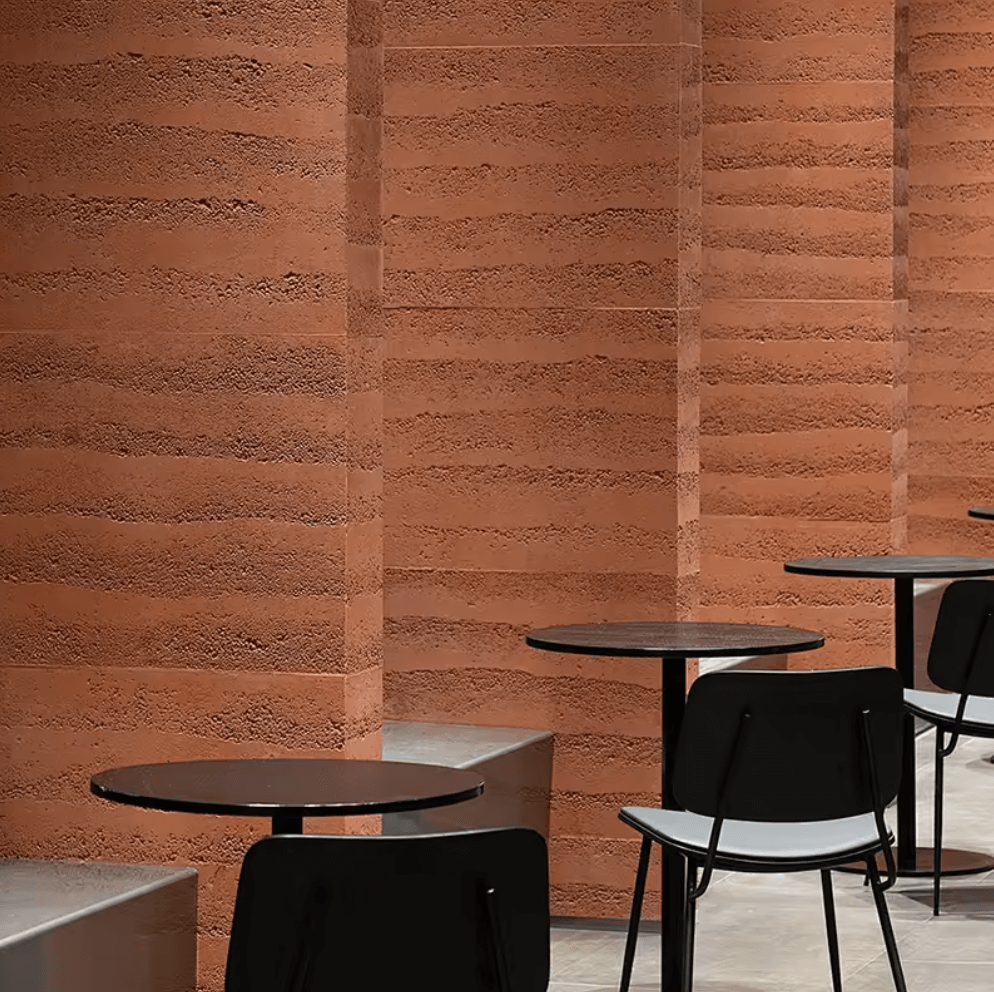
Metal Cladding Trade-offs
Metal cladding in desert heat creates more maintenance problems than it solves.
Metal panels expand and contract sharply with temperature. At roughly 23 × 10⁻⁶ per °C, a 10-metre aluminium run grows by close to 10 mm across a 40°C swing. That movement works its way into fasteners and joints, and over repeated cycles it leads to fatigue failures. The problem is structural before it is cosmetic.
- Heat-island contributor: Surfaces can exceed 80°C, radiating heat into the building envelope and raising cooling loads.
- Sand abrasion: Wind-driven sand strips protective coatings. Once bare metal is exposed, corrosion accelerates — especially in coastal zones such as Jeddah or Abu Dhabi.
- Maintenance overhead: Recoating is a recurring operational cost that most developers underestimate during the specification phase.
None of this makes metal unusable — in the right application it is a sound choice. But if you are running a hotel asset where zero downtime is the mandate, the trade-offs stack against metal. Lightweight MCM soft stone, by contrast, barely expands under the same conditions, does not radiate stored heat, and carries an ASTM E84 Class A fire rating without the recurring recoating.
Concrete Cladding Limitations
Concrete cladding in desert climates fails predictably — not from age, but from thermal movement and self-weight.
In Riyadh or Dubai, a concrete facade panel can see a daily temperature swing of roughly 25–30°C. That is not an extreme event — it is an ordinary day. Concrete’s coefficient of thermal expansion sits around 10 × 10⁻⁶ per °C, so a 3-metre panel moves about 0.75 mm through that swing, every day. Over five years the cumulative cycle count runs into the thousands. Joint sealants crack, and hairline fractures propagate into water-ingress paths, turning a monolithic-looking skin into a maintenance liability.
The bigger problem is weight. A 75 mm precast concrete cladding panel weighs on the order of 180 kg/m². For a 40-storey tower in Jeddah, that weight cascades into larger columns, deeper foundations, and heavier crane time on site. You are not just paying for cladding — you are paying for the steel and concrete required to carry it. Compare that with an MCM flexible stone panel at 1.5–6 kg/m². The dead-load reduction is not marginal; it is an order of magnitude, which reshapes the structural frame budget on high-rise work.
Then there is the installation bottleneck. Concrete panels require tower cranes, lifting clutches, and anchor systems. Flexible stone MCM, applied with a notched trowel and adhesive directly onto the substrate, needs none of the heavy lifting. For projects where the main contractor is already fighting a schedule, that difference compresses the facade programme.
- Thermal-stress cracking: Daily expansion-contraction cycles open micro-cracks at panel joints over a few years. Once water penetrates, rebar corrosion accelerates — and repair often means full panel replacement, not patching.
- Self-weight penalty: At roughly 180 kg/m² versus 1.5–6 kg/m² for MCM, concrete multiplies structural steel tonnage. Every kilogram removed from the facade is a kilogram the frame no longer has to carry.
- Installation logistics: Precast panels demand crane scheduling, laydown-yard space, and lifting-crew coordination. Urban infill sites and hotel refurbishments rarely have that luxury.
When a project shifts from a heavy precast skin to a thin MCM panel, the substrate preparation — levelling compound and primer — can replace anchor embeds and grouting. Because a factory-made panel holds a tighter surface tolerance than a site-cast one, there is also less variation to reconcile on site, which reduces rework.
Concrete’s porosity is a slower-burn risk. Even with hydrophobic admixtures, unprotected concrete can absorb and hold moisture, and in climates that still see occasional flash flooding, stored moisture drives spalling and efflorescence over time.
Concrete remains a sensible choice where extreme impact resistance is non-negotiable — vehicle barriers, ground-level plinths, or security-rated perimeters. But for the vertical facade of a hotel, mall, or residential tower in the Gulf, specifying concrete is increasingly a cost premium disguised as a durability decision. The material is not wrong; it is just heavy, thermally active, and slow to install — three traits that work against a project manager’s budget and programme in every desert city.
Verdict for UAE/Saudi Projects
In the Gulf, your cladding choice determines whether you pay once or pay repeatedly.
The material that looks flawless in a Milan showroom can become a maintenance liability before the first snagging inspection is finished. The desert does not care about design awards. It imposes three non-negotiable tests — thermal shock, UV bombardment, and airborne sand erosion — and your shortlisted cladding either passes or fails expensively.
- Solar Reflectance and Cooling Load: Metal cladding — particularly dark anodised aluminium — routinely reaches surface temperatures above 80°C on summer afternoons, and that heat conducts into the building envelope, forcing HVAC systems to work harder. MCM flexible stone stays significantly cooler because it conducts less heat and is available in lighter tones.
- Thermal Movement Management: Aluminium expands at roughly 23 × 10⁻⁶ per °C, so across a 50°C swing a 100-metre facade run absorbs around 11 cm of cumulative movement through its expansion joints. If those joints are installed incorrectly — or value-engineered out — you will see buckling within a couple of seasonal cycles. MCM panels, with a polymer-modified matrix and embedded glass-fiber mesh, handle the same movement by flexing rather than transferring stress to the fastening system.
- Sand Abrasion — the Hidden Cost Driver: Wind-driven silica is unforgiving to any thin protective coating: coated metal panels lose film thickness over time, and concrete surfaces develop micro-pitting that traps dust and moisture. MCM flexible stone, with its UV-resistant 3D inkjet surface layer, shows minimal texture degradation under the same exposure. If your project is in an open location — Al Ain, or the outskirts of Jeddah — this matters more than the spec sheet suggests.
Now consider the specification that Gulf procurement teams increasingly demand: fire performance. MCM flexible stone tested to ASTM E84 achieves Class A — not because of additives, but because the core material (modified clay with inorganic binders) is inherently non-combustible. Concrete also passes, of course, but at a dead-load penalty that pushes structural engineers into heavier steel frameworks. Metal composite panels with a combustible core, by contrast, are being rejected at municipality review in both Dubai and Abu Dhabi as fire-code enforcement tightens.
The conversation nobody has early enough is about sample approval and colour tolerance. When you are ordering several thousand square metres of travertine-textured MCM for a hotel porte-cochère, the pre-production sample is not a formality — it is your only binding visual reference. Too many five-star projects have seen batch colour drift because nobody wrote an acceptable tolerance into the sample-approval form. Fix it in writing: agree an explicit colour tolerance against the approved sample, and confirm it before the production run starts.
Here is a benchmark you can use in your next supplier negotiation: for a large facade programme in Saudi Arabia, switching from a heavy composite or concrete skin to thin MCM flexible stone reduces shipped volume per square metre and removes the need for a secondary steel sub-frame in low-rise sections. The larger saving, though, is installation speed — a thin panel fixed with full-spread adhesive on a levelled substrate needs no crane and no clip-and-rail alignment, so the facade programme runs on a fraction of the rigging and labour.
Concrete cladding still has its place — ground-floor plinths, blast-resistant zones, security-rated perimeters. But for most applications above the first floors, the maths shifts. A precast panel measured in centimetres weighs an order of magnitude more than an MCM panel measured in millimetres, and the structural steel savings alone can offset the difference in cladding material cost over the life of a high-rise.
The verdict for UAE and Saudi projects: if your facade is above ground level, non-structural, and you care about cooling load, installation speed, and long-term colour stability, flexible stone MCM is the hard-nosed engineering choice. If someone on your value-engineering committee is pushing metal, ask them to produce thermal imaging from a comparable Gulf project taken at 2 PM in August. If they cannot, the decision has probably made itself.
Conclusion
The cladding decision for desert projects does not end at the specification sheet. It ends at the quality tolerance you agree before the first panel leaves the factory. Metal transfers heat, concrete spalls under thermal shock and carries heavy dead load, and any cladding fades or chalks when its finish is only skin-deep. The difference between a long-life facade and an early liability is how the supplier handles a small deviation in sample approval versus mass production.
Request a technical data sheet that includes the ASTM E84 fire-rating results and the EN 13501-1 classification, then confirm the light weight and formats that fit your structure. If the supplier delivers those documents along with a clear FOB pricing breakdown for your port — Dubai, Jeddah, or Doha — you have found a partner who understands the region. Reach out to Lily at JMS Decor to discuss your project parameters and get a spec sheet matched to your site conditions. The right cladding partner will send data before they ask for a purchase order.
Frequently Asked Questions
Is MCM better than metal in desert heat?
For most non-structural facades, yes. MCM avoids the thermal expansion and coating degradation that affect metal panels, because its resin-bonded matrix flexes and absorbs movement instead of transferring stress to fasteners. Its ASTM E84 Class A core is also inherently non-combustible. Confirm substrate primer and adhesive for extreme heat before ordering.
How does flexible stone handle sand abrasion?
Flexible stone resists sand abrasion better than painted metal because the stone-like surface is integral, not a thin coating. In desert storms, minor surface etching does not expose a corrodible substrate. Order travertine-textured samples for on-site abrasion testing.
What fire rating does MCM offer for UAE projects?
JMS MCM panels achieve ASTM E84 Class A (flame spread ≤25, smoke developed ≤450), meeting strict GCC high-rise cladding codes, and also carry EN 13501-1 Class A2 for European specifications. Unlike some metal composite core panels, the modified clay material is inherently non-combustible. Share your project specs for compliant fire test documentation.