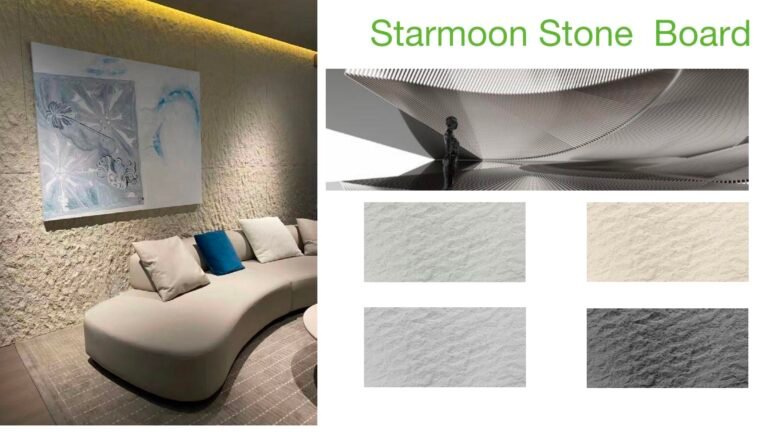
A supplier says the defect rate is below 1%. On a 300 m² order that sounds like three square metres — but the number your client sees is panels, not square metres, and the two do not convert the way most buyers assume. A standard 1200 × 600 mm panel covers 0.72 m², so 300 m² is about 417 panels, and 1% of the panel count is about four panels. Whether four is acceptable depends on what counts as a defect, how the sample was drawn, and what the purchase order says. This guide works through the arithmetic, the sampling logic, and the wording that makes the claim enforceable.
How many panels are in a 300 m² order?
The conversion is straightforward once you know the panel format. A 1200 × 600 mm sheet covers 1.2 × 0.6 = 0.72 m². Divide the order area by that number and round up, because you cannot buy a fraction of a panel.
| Format | Area per panel | Panels in 300 m² |
|---|---|---|
| 1200 × 600 mm (standard) | 0.72 m² | 417 |
| 1200 × 2900 mm (large format) | 3.48 m² | 87 |
Two details change the count. First, the order area usually includes a waste allowance, so the purchased area is higher than the installed area; the panel count should be based on what you buy, not what ends up on the wall. Second, a wall with many openings or a strong pattern match may need more material, which raises the panel count again. The 417 figure is the baseline for a simple 300 m² order with no waste allowance.

Does “below 1%” mean area or panel count?
The two readings give similar numbers but different conversations. One percent of 300 m² is 3 m². One percent of 417 panels is about 4.17 panels. Four panels at 0.72 m² each is 2.88 m², so a four-panel defect count is roughly consistent with the 3 m² area reading.
The readings diverge when defects are concentrated. One panel with a large area of surface damage can be 0.7 m² of defective material but only one panel; four panels with small edge chips can be four defects but a small fraction of a square metre. If the contract does not say whether the rate is measured per panel or per square metre, both sides can be right and the argument has no resolution.
There is a second ambiguity: “below 1%” is an upper bound, not a prediction. A batch can be at 0%, at 0.4%, or at 0.9% and still satisfy the sentence. The buyer’s protection is not the number; it is the inspection and the remedy written into the order.
What counts as a defect?
A defect rate without a definition is a marketing number. For flexible stone, separate the categories before you discuss percentages.
- Functional defects. Delamination between the stone face and the backing, a crack through the sheet, backing separation at a cut edge, thickness or weight outside the declared band, or a panel that fails the agreed bend test. These affect performance and should not be installed.
- Cosmetic defects. Edge chips, surface marks, colour outside the approved sample range, or pattern misregistration. Some are acceptable if they fall on a cut edge or in a concealed area; others are not.
- Packaging defects. Crushed corners, wet packs, or missing batch labels. These are acceptance items in their own right, not part of the panel defect rate.
The acceptance criteria should be written per property: thickness band, weight band, minimum bend radius, mesh coverage, colour against the retained sample, edge condition, and packaging. A panel that meets every criterion is not a defect even if it looks different from its neighbour; natural variation is expected within the approved range.
Does the defect rate apply to my shipment or to the whole production run?
This is the question most buyers never ask, and it changes what the number means. A factory’s “below 1%” is usually measured across a production period — a month, a quarter, or a rolling average — not on the specific lot that goes into your container. A run of 10,000 m² at 0.8% can still produce a container with a cluster of defects, because defects tend to concentrate around a shift, a pigment lot, or a machine adjustment rather than spreading evenly.
Ask whether the rate is per batch or a company average, and ask for the defect count recorded for your batch. A supplier that tracks real numbers can answer; a supplier that only has a brochure figure will not. If the number is an average, treat it as context, not as an acceptance criterion — your protection is the sampling plan and the remedy, not the average.
The COA describes the batch, but it does not usually report the defect distribution. That is another reason to inspect the actual panels rather than rely on a document that was written before the container was packed.
Can a sample prove a below-1% defect rate?
Usually not, and the arithmetic is the reason. If you inspect 50 panels and find zero defects, a standard statistical rule (often called the rule of three) puts the 95% upper confidence bound at about 6%. Finding zero in 50 does not prove the rate is below 1%; it only shows the rate is unlikely to be above roughly 6%.
To bound the rate below 1% with zero defects at 95% confidence, you need to inspect roughly 300 panels — most of a 417-panel order. Inspecting 100 panels gives an upper bound of about 3%. A sample of 80 gives about 3.75%. The smaller the sample, the weaker the claim.
This is why a sampling plan matters more than the headline number. The plan defines the sample size, the acceptance number, and the risk both sides accept. The NIST/SEMATECH acceptance sampling reference explains the logic; the numbers for your order should be agreed with the supplier, not copied from a generic table.
What sampling plan should I agree before production?
A workable plan answers five questions: what is the lot, how many panels are sampled, how many defects are allowed, what happens if the limit is exceeded, and who inspects. The table below shows the form of the plan; the values are an example to discuss, not a recommended standard.
| Element | مثال على ذلك | Why it matters |
|---|---|---|
| Lot size | 417 panels | Defines the population the rate applies to |
| Sample size | 80 panels, randomly drawn across pallets | Random drawing prevents a “golden pallet” |
| Acceptance number | عيب واحد مسموح به | يحدد نقطة القبول/الرفض قبل التفتيش |
| رقم الرفض | عيبان أو أكثر | يُفعّل الفرز، إعادة المعالجة، أو إعادة التفتيش |
| Inspector | Factory QC plus buyer’s representative or third party | Separates the party with an interest from the decision |
If the product is a feature wall or a hotel lobby where every panel is visible, consider 100% inspection instead of sampling. It is slower and more expensive, but it is the only way to know the actual count rather than a confidence bound.

How do I write the defect clause into the purchase order?
The clause should make the claim testable. A practical structure:
- Unit. State whether the rate is per panel or per square metre, and whether a panel with several defects counts once or several times.
- Definitions. List functional, cosmetic, and packaging defects, with the acceptance criteria for each property.
- Sampling. Name the sample size, the acceptance number, the drawing method, and the inspection point (pre-shipment).
- Remedy. Say what happens when the limit is exceeded: sort and replace, rework, re-inspect, credit, or reject the lot.
- Evidence. اشتراط إرفاق الصور، وأرقام التعريف للوحات، وأرقام الدفعة، وتقارير الفحص مع الشحنة.
- التوقيت. تحديد الموعد النهائي لتقديم المطالبة، واللحظة التي يُعتبر فيها المشتري قد قبل الشحنة.
معدل العيوب المُعلن لدينا أقل من 1%، وترافق سجل الدفعة وشهادة التحليل الشحنة. هذه البند هو ما يحوّل هذا الإعلان إلى أمر قابل للتحقق والإنفاذ من قِبَل المشتري.
ماذا أفعل عندما يتجاوز العدد حد المطالبة؟
احتفظ باللوحات المتأثرة، وثبّت تفاصيلها، وصنّف العيوب قبل اتخاذ قرار بشأن التعويض. إذا كانت العيوب جمالية ومحصورة، فإن فرز واستبدال اللوحات المتأثرة عادة ما يكون أسرع من رفض الدفعة بالكامل. وإذا كانت وظيفية أو منتشرة عبر الدفعة، فيجب إعادة فحص الدفعة أو استبدالها. خطة استرداد فشل الفحص تغطي التفاصيل خطوة بخطوة، و batch consistency check يوضح كيفية مقارنة اللوحات المستبدلة بالعينة المعتمدة.
الأسوأ هو تركيب اللوحات المعيبة للحفاظ على الجدول الزمني والمفاوضة لاحقاً. بمجرد رفع الجدار، لم يعد الحل عبارة عن فرز؛ بل يصبح إزالة. إذا كنت لا تزال تحدد طلب الشراء، فإن الملمس الحجري المرن يسرد أحجام اللوحات ومدى السماكات المحددة لعدد اللوحات.
الأسئلة الشائعة
هل معدل عيوب أقل من 1% هو ضمان؟
لا. إنه معدل مُعلن لدورة إنتاج. الحماية القابلة للإنفاذ تكمن في معايير القبول والتعويض الوارد في أمر الشراء، مدعوماً بفحص قبل الشحنة.
هل 1% تعني 3 أمتار مربعة أو 4 لوحات؟
كلا القياسين ممكن. من حيث المساحة، 1% من 300 متر مربع تساوي 3 أمتار مربعة. ومن حيث عدد اللوحات، 1% من 417 لوحة تساوي حوالي 4.17 لوحة. يجب أن يحدد العقد الوحدة المطبقة.
Can I inspect every panel?
Yes. For a visible feature wall or a high-value project, 100% inspection is the only way to know the actual defect count rather than a statistical bound. It adds time before shipment.
What sample size proves a rate below 1%?
With zero defects and 95% confidence, roughly 300 panels. Smaller samples can only bound a higher rate — about 6% for 50 panels, about 3% for 100 panels.
Should I reject the whole lot for four defective panels?
Usually not, if the defects are cosmetic and isolated. Sort and replace the affected panels, re-inspect, and document the result. Reject the lot when the defects are functional or spread across the batch.
Does the defect rate include packaging damage?
It should be a separate acceptance item. Crushed corners, wet packs, and missing labels are packaging defects and should have their own criteria and remedy.